
Asadal
Aktobe Region • Asadal. 19th century. Karaganda Region. 103 x 645 x 47. Inlaid with patterned bone plates.A. Kasteev National Museum of Kazakhstan
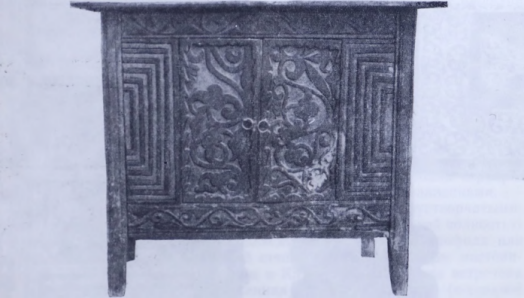
Asadal is a cupboard designed for storing dishes and food. The name of the cupboard, consisting of the words “As” and “Adal”, means “noble food”. Only clean dishes and food were placed in the cupboard so that, according to popular belief, evil spirits could not touch them at night. In a yurt, the asadal was placed on the left side, in the kitchen area. Asadals typically have four small, stable legs. Researchers have noted that craftsmen made single-door and double-door asadals and sometimes added pull-out drawers. The cabinet doors were decorated with carved or colourful ornamentation, featuring a carpet-like pattern with highlighted central rosettes (rectangles, rhombuses, circles, etc.) and border frames. Often, the bas-relief carving on the doors of the asadals combined floral and geometric motifs and was complemented by polychrome painting and bone inlays, adding compositional polyphony to the overall decor. An example of this is a cupboard for dishes, seen by E.A. Masanov during his research expedition in the mid-20th century. The symmetrical part of the interior ornament on the left and right doors of the cupboard with asymmetrical smooth curves of trefoils – ush zapyrak , and a floral motif, gyul oyu, contrasts with the clearly constructed parallel lines of half a square, reminiscent of the parallel stitching technique used in felt blankets, syrmak (Margulan 34). The ornamental central composition is completed by horizontal borders decorated with the islimi motif. The vertical borders are formed by the planes of the vertical slats, which transition into the details of the legs. The contrast between the ornamental plant and geometric lines creates a visually expressive tension that attracts the eye.The front part of the asadal is interesting, decorated with bone plates with curved edges and openwork carving from the collection of the A. Kasteev Museum of Art of Kazakhstan. The bone plates were used by the craftsman to create the decoration of two vertical tiers of panelled cabinet doors and wide strips around them, creating a unique border for the overall composition with rhythmically repeating carved bone plates on the left and right. The carved ornament inside the plates varies in elements in the form of “horseshoes”. Structurally, the ornamental border includes a horizontal crown, similar to the one on the opposite side of the asadal. On the sides of the door panels and along the lower triangular inserts, there are chains of engraved triangles. The most expensive ornamented items were considered to be pieces of furniture completely covered with patterned bone plates.