Traditional and contemporary art of Kazakhstan

A Virtual Journey into the World of Kazakhstan’s Artistic Heritage

This Web Gallery presents the diversity of artistic practices in Kazakhstan, reflecting the continuity of cultural traditions and the dynamic development of contemporary creative processes. The virtual exhibition features works based on national images, symbols, and themes, as well as artworks by contemporary artists who reinterpret the country’s cultural heritage through contemporary artistic forms, expressive means, and modern technologies.

The selected works demonstrate the relationship between traditional and contemporary art, revealing the distinctive features of the national worldview, cultural identity, and cultural meanings. The presented materials allow viewers to trace how elements of historical and cultural heritage are reflected in contemporary artistic practice, while maintaining their significance and relevance in an increasingly globalized world.

The Web Gallery is aimed at promoting Kazakhstan’s artistic heritage, expanding public access to works of art, and fostering a lasting interest in national culture and art among a wide audience.

Ceramic dish.

18th–19th centuries. Kultobe settlement. Photo by E.S. Kazizova
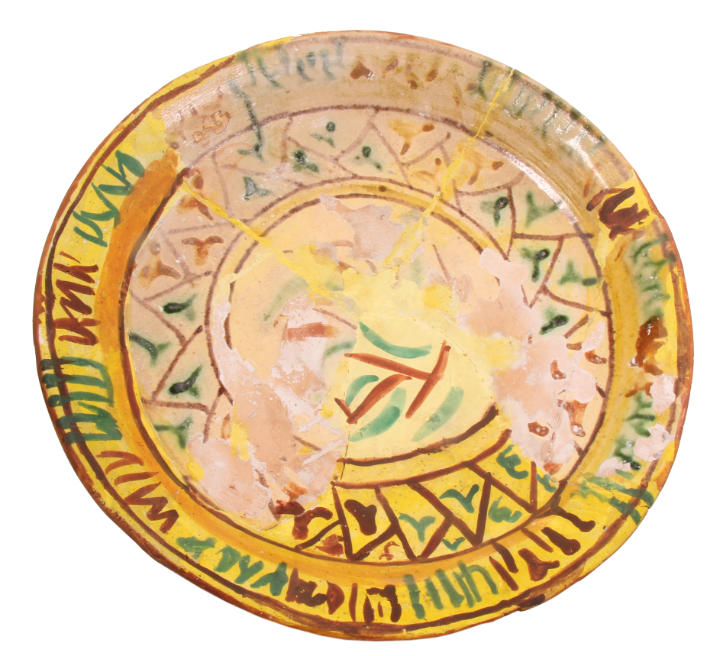
This 18th–19th-century ceramic dish is an example of traditional glazed pottery. The diameter of the piece is 35 cm, and its height is 6 cm.The decorative design is based on a combination of lemon-yellow glaze and two-colour painting: green and brown-manganese. The composition is arranged according to a concentric principle: the central field is accentuated by a large, freely interpreted symbol of a botanical-symbolic nature; surrounded by ornamental bands featuring rhythmically repeating elements—strokes, triangles, zigzag and wavy lines. This arrangement reflects a synthesis of geometric and plant motifs.A characteristic feature is the painterly manner of execution: the fluidity of the lines, localised glaze runs and the variability of the brushstrokes.The predominance of the colour yellow, apart from its decorative function, can be viewed in a symbolic light. In the context of the Sufi tradition, it corresponds to notions of light and spiritual ascent.