
Tumarsha
Kyzylorda Region. Silver, gilding, stamping, granulation, filigree. A. Kasteyev National Museum of Arts of the Republic of Kazakhstan
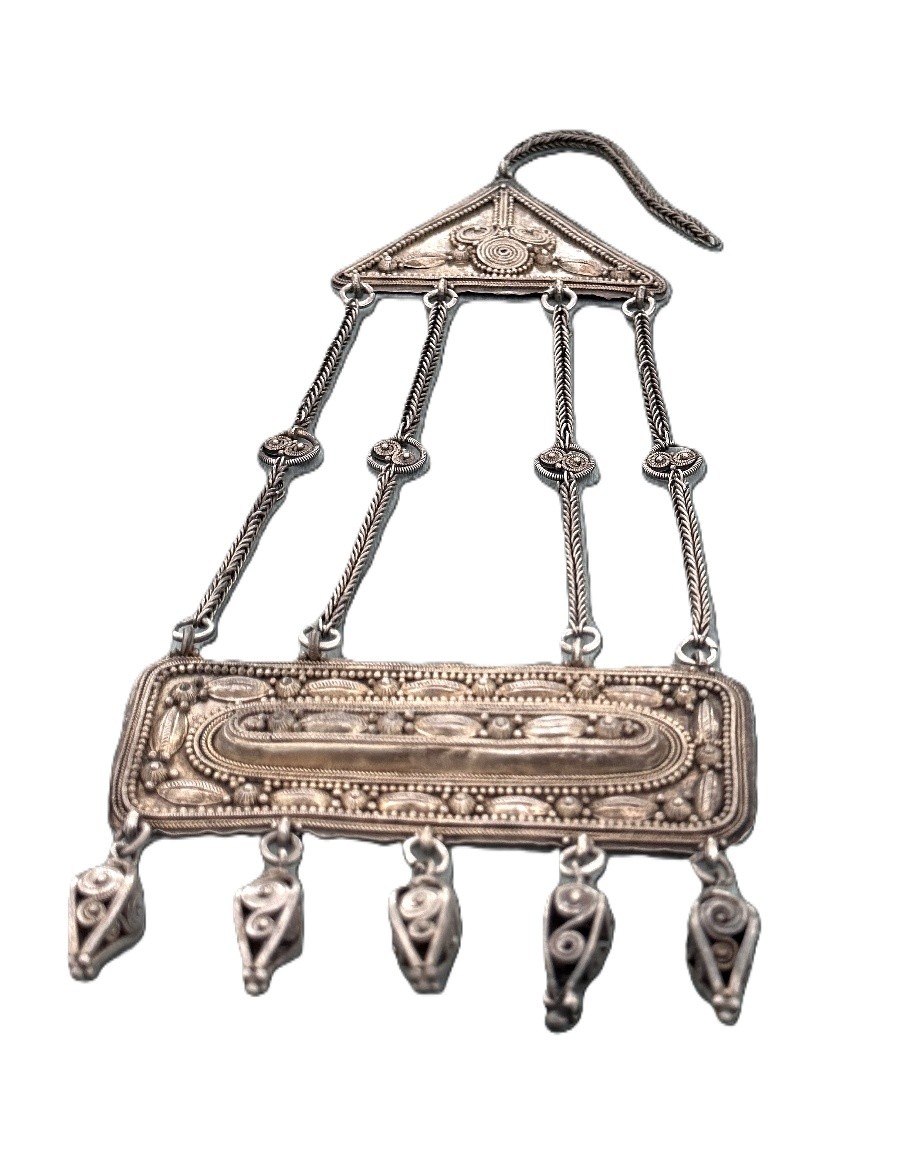
Tumarsha, a triangular pendant amulet. The item belongs to the category of neck and chest amulets, which served a protective function and formed part of the traditional costume ensemble.The design comprises an upper triangular amulet body attached to a twisted chain. Several vertical chain pendants extend from its lower edge, connecting the upper element to a horizontal plate. The lower plate is complemented by a series of three-dimensional teardrop-shaped pendants attached to rings. All elements are connected in a movable manner.The composition is structured along a vertical axis, clearly divided into three zones: the upper (triangular amulet), the middle (system of chain links) and the lower (horizontal plate with pendants). The central axis is emphasised by a hierarchy of forms: from the compact upper element to the more elongated lower part.The ornamental scheme combines geometric and spiral motifs. The surface of the triangular body is decorated with concentric and linear ornamentation, with a round rosette element placed at the centre. The lower plate is adorned with a relief band featuring grain and oval medallion decoration. The pendant elements are executed using the scani technique, which creates openwork spiral structures.The pendants create a distinct sense of movement and produce an acoustic effect when in motion. Overall, the piece demonstrates a characteristic combination of the amulet’s sacred function with a developed decorative composition, where form and ornamentation emphasise the protective significance of the ornament.