
Bilezik
West Kazakhstan. Silver, glass, gilding, stamping, filigree, granulation. A. Kasteyev National Museum of Arts of the Republic of Kazakhstan
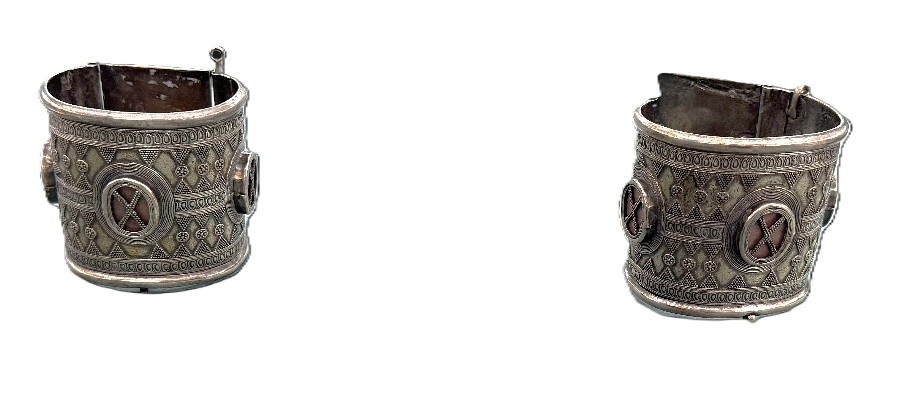
A Bilezik is a cuff-style wrist ornament characteristic of the 20th-century jewellery tradition of Western Kazakhstan. The piece belongs to the category of substantial ceremonial jewellery and served a distinct decorative and status-symbol function.The material is silver with gilding; decorative elements include coloured glass inlays. The technique combines stamping, chasing, filigree and granulation, creating a complex, multi-layered surface texture.The design consists of a wide cylindrical base of an almost closed type with a hinged joint and a clasp. This shape ensures a secure fit on the wrist and is characteristic of more complex, technically advanced pieces. Protruding circular plates are situated on the sides, enhancing the piece’s three-dimensional form.The composition is organised according to the frieze principle, with a clear division into horizontal bands. The central field is filled with rhythmically repeating diamond-shaped elements with a grain-like texture. The key focal points are large round medallions with inlays, designed in the form of applied discs. The ornamental bands at the top and bottom form a closed frame structure, emphasising the tectonics of the form.The ornamental scheme combines geometric and solar-symbolic motifs. The round overlays with cross-shaped elements at the centre can be interpreted as variations on protective symbols. The use of scani and graining enhances the decorative richness and creates the effect of a shimmering surface. The contrast between smooth, gilded and relief-finished sections lends the piece expressiveness and highlights the high level of craftsmanship.