
Kudagi yuzik
West Kazakhstan. Silver, glass, gilding, stamped, filigree. A. Kasteyev National Museum of Arts of the Republic of Kazakhstan
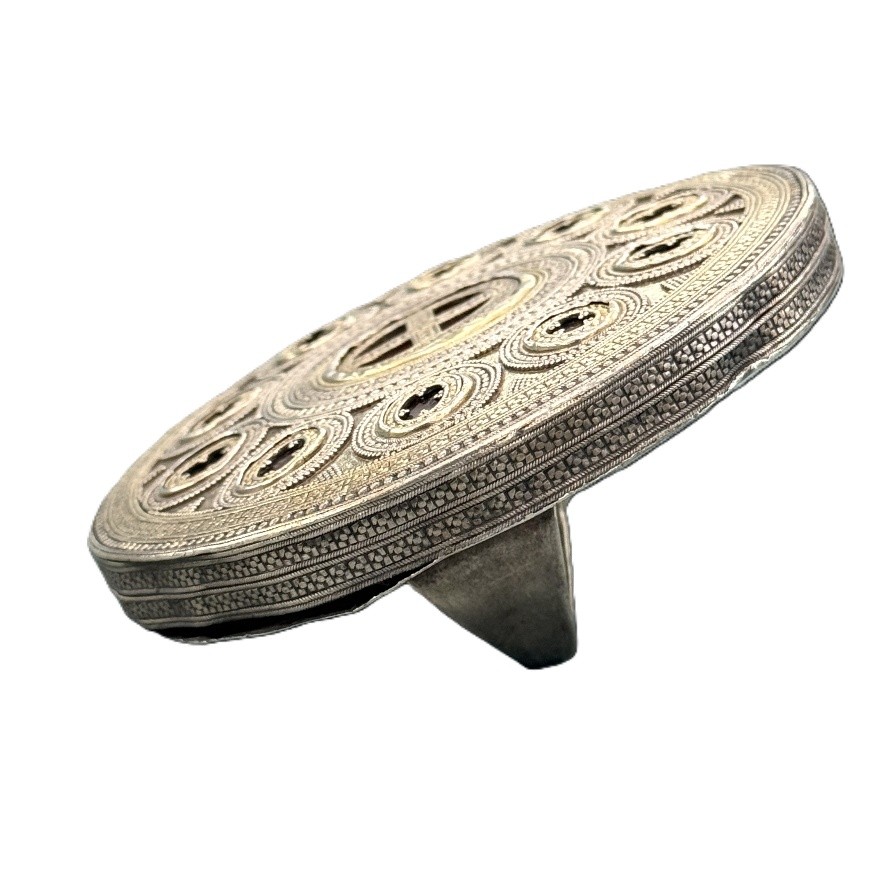
Ring (juzik), ‘kudagi juzik’ type (matchmaker’s ring). The ring belongs to a specific type of traditional women’s jewellery intended for ceremonial and status purposes, associated with the institution of matchmaking and the family hierarchy (kudagi — the eldest woman on the bride’s or groom’s side).The design is characterised by its large-scale form: a massive shank transitions into a significantly widened disc-shaped shield, raised above the base. The shield has a flat-convex shape with a pronounced rim, decorated with an ornamental band. The internal structure is multi-layered, with decorative elements superimposed on the main plate.The composition is arranged according to a concentric principle with a clearly defined centre. A cross-shaped motif is situated in the central zone, around which a system of concentric ornamental bands is arranged. Symmetrically distributed circular recesses with glass inserts are situated around the periphery, forming a rhythmic structure and enhancing the decorative richness.The ornamental system combines geometric and solar-symbolic motifs. The cross-shaped element in the centre serves as the compositional and conceptual core, associated with the ideas of protection and stability. Concentric bands with fine grain and filigree decoration create an effect of multi-layering and a visual ‘unfolding’ of the form. The use of gilding and glass inlays heightens the contrast and emphasises the status of the piece.The scale, complexity of construction and richness of the decoration indicate that the ring belongs to the category of ceremonial jewellery, which fulfilled not only a decorative but also an important social and representational function in traditional culture.