
Kobyz
Wood, bone, leather, metal, carving, inlay. A. Kasteev National Museum of Arts of the Republic of Kazakhstan
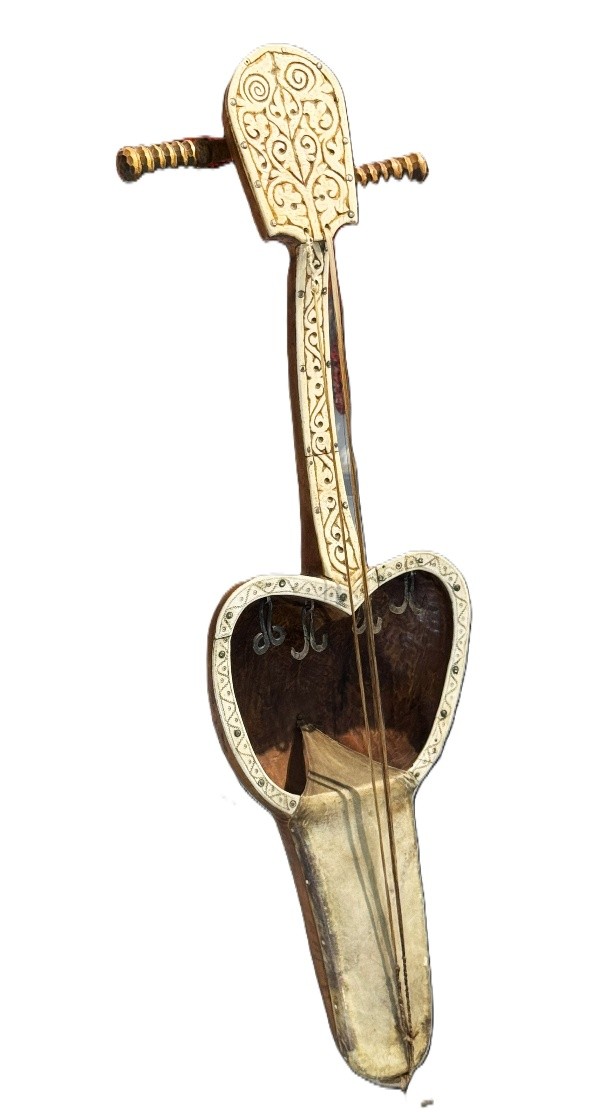
Kobuz The artefact is a traditional stringed bowed musical instrument — the kobuz — belonging to the category of everyday and sacred-ritual forms of Kazakh culture. The design features an elongated body with a bowl-shaped resonator, transitioning into a long neck and ending in a sculpted head.The resonator is made from a single piece of wood, hollowed out from the inside, and partially covered with a leather membrane, which ensures the instrument’s acoustic properties. The lower part of the body is elongated and tapered, forming a characteristic shape with a pronounced vertical orientation.The neck and upper part of the body are decorated with bone inlays featuring ornamental carving. The ornamentation consists of plant and zoomorphic motifs arranged in linear compositions that emphasise the structural axes of the instrument. The contour lines of the pattern are characterised by their clarity and rhythmic repetition.The head of the instrument has an elongated shape with a flat composition, decorated with symmetrical ornamentation. Metal suspension elements are fixed inside the soundbox, serving an additional acoustic and symbolic function.Compositionally, the object is constructed along a vertical axis, with an emphasis on the relationship between the massive resonator section and the elongated neck. The contrast of materials (wood, bone, leather) forms a complex textural structure.Technologically, the instrument is crafted using wood carving, bone inlay and hand assembly. The tensioning of the strings and the fastening of the parts are achieved using traditional construction techniques.The kobuz is not only a musical instrument but also a bearer of cultural and symbolic significance linked to shamanic and epic traditions. Its artistic design demonstrates the integration of utilitarian, acoustic and decorative functions within a single object.