
Jailau, 2016. Bronze, plastic, glass
Zhanna Nogerbek
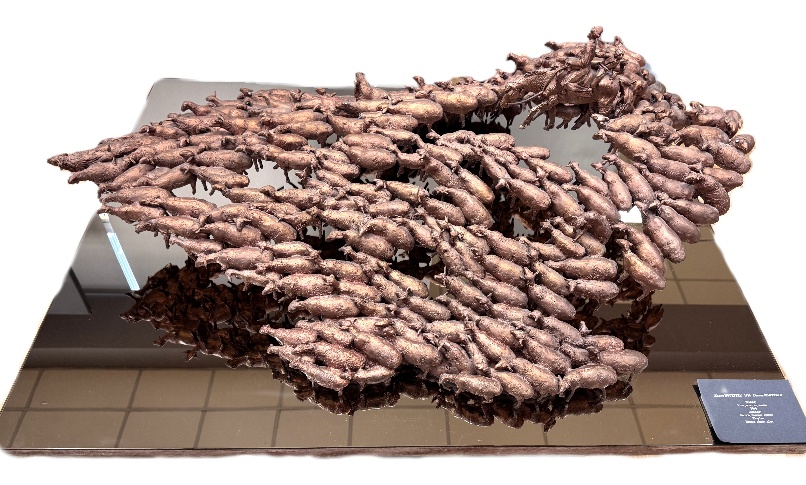
The sculptural structure of the work unfolds in horizontal space as a single, rhythmically organised mass, built upon the repetition of numerous miniature animal figures. The individual elements are not perceived in isolation — they merge into a dense, fluid surface reminiscent of a living relief, where the individual dissolves into the collective movement.The composition lacks rigid centrality, yet within this visual flow the figure of a horseman gradually emerges, serving as the work’s semantic and rhythmic core. It is this figure that sets the direction of movement and organises the chaotic multitude into a unified plastic system. This creates a tension between the free expansion of form and a hidden internal order.The interplay of materials and surfaces takes on particular significance. The rough texture of the bronze enhances the sense of natural force, density and the almost tangible materiality of the image. At the same time, the glass base introduces an additional spatial dimension: the reflection duplicates the forms, visually expanding the composition and creating the effect of the herd’s endless movement beyond the limits of its actual volume.In the artist’s interpretation, the image of the jailau is stripped of ethnographic literalism and is perceived not as a landscape scene, but as a metaphor for continuous movement and collective existence. The space of the steppe is revealed here as a medium for the circulation of life, memory and the rhythm of nomadic culture. The repetition of figures becomes a kind of visual equivalent of migration, where movement becomes the basis of existence.