Traditional and contemporary art of Kazakhstan

A Virtual Journey into the World of Kazakhstan’s Artistic Heritage

This Web Gallery presents the diversity of artistic practices in Kazakhstan, reflecting the continuity of cultural traditions and the dynamic development of contemporary creative processes. The virtual exhibition features works based on national images, symbols, and themes, as well as artworks by contemporary artists who reinterpret the country’s cultural heritage through contemporary artistic forms, expressive means, and modern technologies.

The selected works demonstrate the relationship between traditional and contemporary art, revealing the distinctive features of the national worldview, cultural identity, and cultural meanings. The presented materials allow viewers to trace how elements of historical and cultural heritage are reflected in contemporary artistic practice, while maintaining their significance and relevance in an increasingly globalized world.

The Web Gallery is aimed at promoting Kazakhstan’s artistic heritage, expanding public access to works of art, and fostering a lasting interest in national culture and art among a wide audience.

‘Qara Shapan’Location: Almaty, junction of I. Panfilov Street and Kabanbay Batyr StreetSource: NUR.kz

Syrlybek Bekbotaev
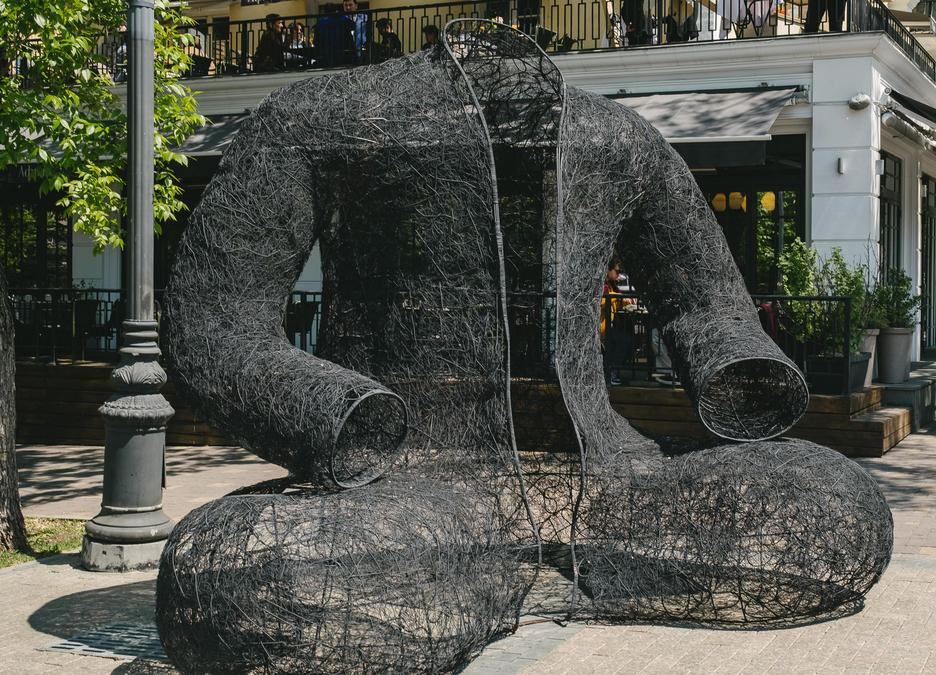
The key artistic technique of the work is the principle of ‘absent presence’. The sculpture reproduces the silhouette of a person sitting in the traditional maldas quru posture (with crossed legs), yet the figure itself is absent: the viewer is presented only with a Shapan that retains the shape of a human body. The empty interior space takes on a meaning of its own, becoming a metaphor for memory, spiritual heritage and collective identity. As a result, the work draws the viewer into the process of interpretation, inviting them to mentally fill the void with their own cultural associations.The openwork structure of the form lends the work particular expressiveness. The sculpture is created from an interweaving of metal rods and wire, forming a complex mesh-like surface. This texture evokes associations with felt fibres, a bird’s nest or natural organic structures. The light filtering through the numerous openings dematerialises the volume, stripping it of its heaviness and creating an effect of airiness and openness.