
The Legend of Love. Korpesh the Goat and Bayan Sulu, 2024. Tapestry, weaving. Source: https://www.ounce.group
Natalia Bazhenova
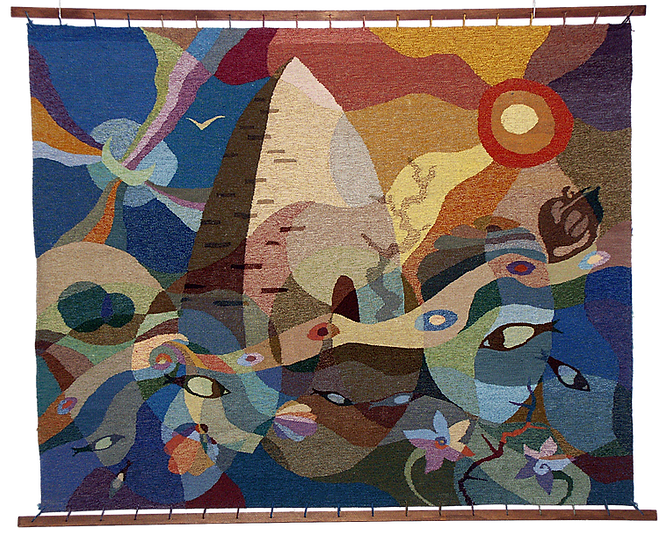
This work is an example of contemporary textile art in which a folkloric narrative is transformed into a system of visual symbols and abstract signs. The artist does not illustrate the legend literally, but translates it into the language of metaphor, where emotional content takes precedence over the narrative thread.Compositionally, the work is structured as a multi-layered symbolic field. In the lower and central zones, stylised forms of eyes and fragments of faces can be discerned, which may be interpreted as signs of memory and presence. These elements create an effect of ‘layering’ within the image: the characters exist not as specific figures, but as traces of experience, fixed within the fabric of the tapestry. The central silhouette of the mazar serves as the compositional and semantic core. Natural motifs—the sun, birds, plant forms—introduce the semantics of life and movement into the composition. They are set against the motif of loss, forming a dual structure of ‘life–death’, ‘love–tragedy’, ‘the earthly–the eternal’. This contrast heightens the emotional tension of the work and emphasises its mythological nature.