
Harmony of the Centuries, 2008 Qushqon: leather, embossingSource: Catalogue of the A. Kasteev National Museum of Fine Arts of the Republic of Kazakhstan, ‘Decorative and Applied Arts of Kazakhstan’, 2025
Zhangir Umbetov and Amangul Ikhanova
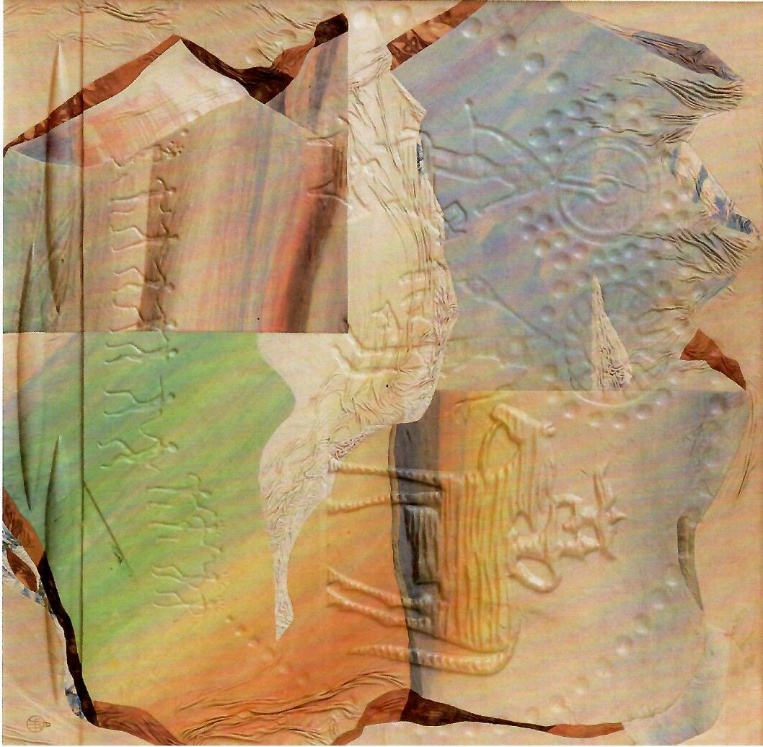
The panel ‘Harmony of the Centuries’ represents an artistic interpretation of one of the most significant monuments of ancient rock art in Kazakhstan. Drawing on imagery from the famous Tamgaly archaeological complex, the artists do not seek to reproduce the petroglyphs literally, but rather create a multi-layered visual reconstruction of cultural memory.The image of the sun-headed anthropomorphic creature, situated at the top of the work, plays a special role. This figure is one of the most famous and enigmatic symbols of Tamgaly and is traditionally interpreted by researchers as a representation of a deity, a shaman or a mythological intermediary between humankind and the cosmos. On the right-hand side of the composition is the silhouette of a horseman, associated with the heroic images of ancient steppe warriors and chieftains. His figure is organically integrated into the structure of the panel and is perceived as a symbol of historical continuity, reflecting the centuries-old tradition of equestrian culture in the Great Steppe. The scene of ritual dance, situated in the lower section of the composition, carries particular symbolic significance. A chain of human figures, united by a shared movement, alludes to ancient ritual practices linked to the cult of fertility, the veneration of natural forces and collective rituals. This motif symbolises the unity of the community, the cyclical nature of time and the harmonious coexistence of humankind with the surrounding world.The surface of the panel is constructed from a combination of fragments of varying textures, shades and directions of relief. This compositional approach creates the impression of an ancient stone slab, the surface of which has been subjected to centuries of exposure to the passage of time and the elements. The colour palette of the work is based on a combination of ochre, sandy, brown and muted green shades. These natural colours evoke weathered rock formations, steppe landscapes and the ancient natural environment in which rock art first emerged.