
Silver earrings from the ‘Family’ collection. Silver; cast and engraved. Source: the designer’s Instagram page — @kazakov_jewelry
Ilya Kazakov
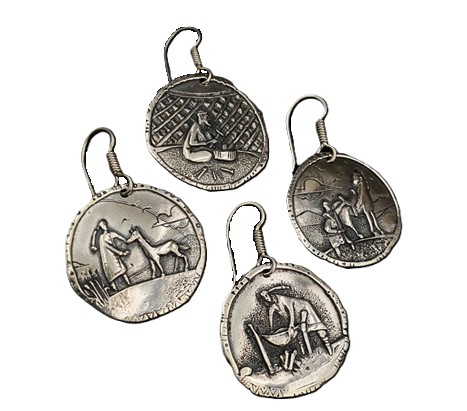
A series of disc-shaped drop earrings, united by a common thematic and sculptural concept, where each piece is crafted as a round medallion with a relief image enclosed within a clear outline. The minimalist form and limited space draw attention to the narrative scene.The circle forms the basis of the artistic concept — serving as both a structural and symbolic element. Within this enclosed form, scenes of interaction between man and horse unfold. The relief is rendered in a generalised manner, without a detailed background, allowing the compositional centre to be perceived more expressively and as a unified whole.The series addresses the theme of family and kinship ties, which are significant to the traditional Kazakh worldview. The images of man and horse represent interconnected elements of nomadic culture, where the animal was an integral part of everyday and social life. The circular form further emphasises the idea of the integrity and continuity of ancestral tradition.In the context of contemporary jewellery art, the work demonstrates a shift away from a purely ornamental language towards narrative sculpture. The artist uses minimalist relief as a means of visual storytelling, transforming the piece not only into a decorative object but also into a vessel of cultural memory.