
‘Mutations’, 2007
Yerbosyn Meldibekov • Installation. Bronze. Height: 28.5 cm; 34 cm; 27 cm;30 cm; 29 cm
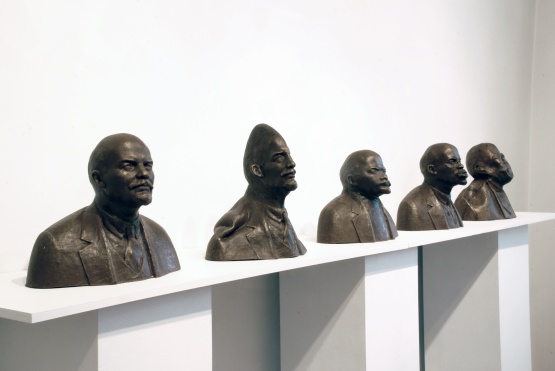
Yerbosyn Meldibekov’s installation ‘Mutations’ brings to mind Salvador Dalí’s surrealist painting ‘Partial Eclipse. Six Apparitions of Lenin at the Piano’, with yellow halos above the leader’s head (1931, 114 × 146, oil on canvas, Centre Georges Pompidou). Having been captivated by the ideas of communism in his youth, Dalí turned to the image of Lenin on more than one occasion. But in Meldibekov’s work, the portrayal of the proletarian leader takes a different conceptual approach. In the installation – comprising five small-scale busts – the sculptor systematically personifies the image of Lenin through various altered anthropological types and artistic styles. The first sculpture on the left is executed in the tradition of Soviet realism, with its idealised glorification of leaders; the second is in the creative style of the Italian sculptor Alberto Giacometti, whose work was characterised by existential states. The third merely resembles Patrice Lumumba, the Congolese leader of the struggle for Congo’s independence. The fourth bust still retains the distorted features of a genetic mutation, whilst the last bears the fierce, radical traces of destruction wrought by its own creator’s hammer. These metaphorical sculptural depictions of Lenin visualise the artist’s personal stance on the ambiguous political debates— —that have raged for over a century regarding Lenin’s role in history and society.
Source: https://aspangallery.com/ru/artists/meldibekov