Traditional and contemporary art of Kazakhstan

A Virtual Journey into the World of Kazakhstan’s Artistic Heritage

This Web Gallery presents the diversity of artistic practices in Kazakhstan, reflecting the continuity of cultural traditions and the dynamic development of contemporary creative processes. The virtual exhibition features works based on national images, symbols, and themes, as well as artworks by contemporary artists who reinterpret the country’s cultural heritage through contemporary artistic forms, expressive means, and modern technologies.

The selected works demonstrate the relationship between traditional and contemporary art, revealing the distinctive features of the national worldview, cultural identity, and cultural meanings. The presented materials allow viewers to trace how elements of historical and cultural heritage are reflected in contemporary artistic practice, while maintaining their significance and relevance in an increasingly globalized world.

The Web Gallery is aimed at promoting Kazakhstan’s artistic heritage, expanding public access to works of art, and fostering a lasting interest in national culture and art among a wide audience.

Fragment of a vessel. Otrar settlement

From the book: The Artistic Culture of Central Asia and Azerbaijan, 9th–15th Centuries. Volume II. Glass. — Samarkand-Tashkent: MICAI, 2011.
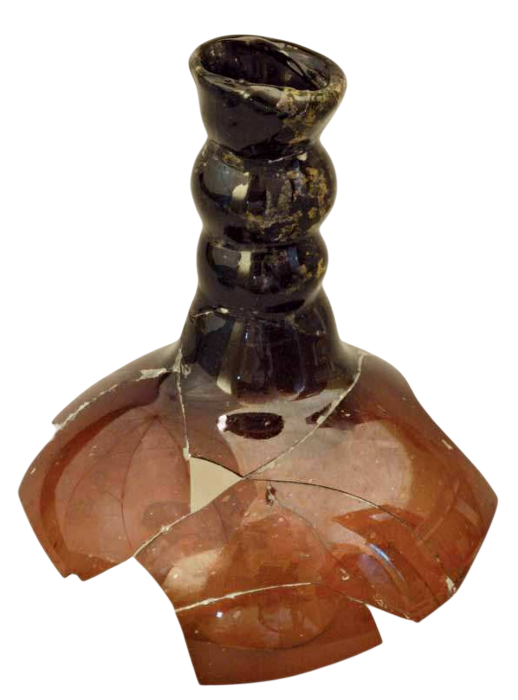
The most striking feature of the vessel is its corrugated, multi-part neck, formed from three successively arranged spherical bulges. This sculptural design lends the silhouette dynamism and an exquisite rhythm, visually complicating the form and making it more elegant. At the same time, this element serves not only a decorative but also a utilitarian function: the textured surface of the neck ensured a comfortable grip on the vessel.The colour of the glass is particularly striking. Unlike the widespread greenish tint caused by natural impurities, this vessel is made of glass with a deep cognac, honey-brown hue. Achieving such a colour required the deliberate addition of metal oxides—primarily iron or manganese—to the glass mass, as well as precise control of the temperature regime during the melting and forming processes.