
Wall alasha carpet, 20 th c.
Mid-20th century. Jambyl Region. Collection of the Central State Museum of the Republic of Kazakhstan
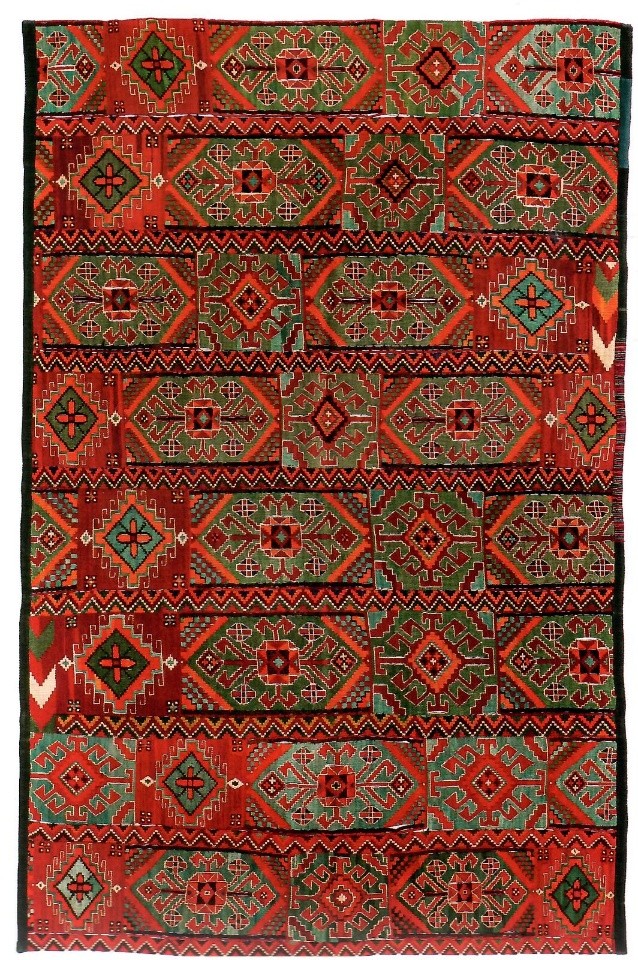
Before us is a fine example of a wall-hanging alash, distinguished by its harmonious colour scheme and rich geometric patterns. In keeping with tradition, the composition is arranged vertically.The ornamental decoration includes diamond-shaped sharshy motifs, as well as botakoz, ormekshi and keregekoz patterns. The narrow bands are adorned with irex ornamentation. This combination creates a complex yet balanced rhythmic system.Semantically, the sharshy (diamond) is associated with the symbolism of the earth, fertility and stability; botakoz (‘camel’s eye’) is traditionally interpreted as a talisman, a symbol of vigilance and protection; ormekshi (‘spider’) is associated with the idea of connection, the weaving of fate and the continuity of existence; keregekoz (‘kerege cell’) resembles the latticework structure of a yurt and symbolises home and ancestral space, whilst irexu (wave-like ornament) corresponds to the image of water – the source of life, movement and purification.The dominant colour of the carpet is a noble shade of red-burgundy, creating a sense of warmth and inner strength. Combined with green, blue, black and white yarn, it forms a rich yet harmonious palette.