Traditional and contemporary art of Kazakhstan

A Virtual Journey into the World of Kazakhstan’s Artistic Heritage

This Web Gallery presents the diversity of artistic practices in Kazakhstan, reflecting the continuity of cultural traditions and the dynamic development of contemporary creative processes. The virtual exhibition features works based on national images, symbols, and themes, as well as artworks by contemporary artists who reinterpret the country’s cultural heritage through contemporary artistic forms, expressive means, and modern technologies.

The selected works demonstrate the relationship between traditional and contemporary art, revealing the distinctive features of the national worldview, cultural identity, and cultural meanings. The presented materials allow viewers to trace how elements of historical and cultural heritage are reflected in contemporary artistic practice, while maintaining their significance and relevance in an increasingly globalized world.

The Web Gallery is aimed at promoting Kazakhstan’s artistic heritage, expanding public access to works of art, and fostering a lasting interest in national culture and art among a wide audience.

Bogzhama 20th c.

Place of manufacture unknown. Mixed weaving. Collection of the Central State Museum of the Republic of Kazakhstan
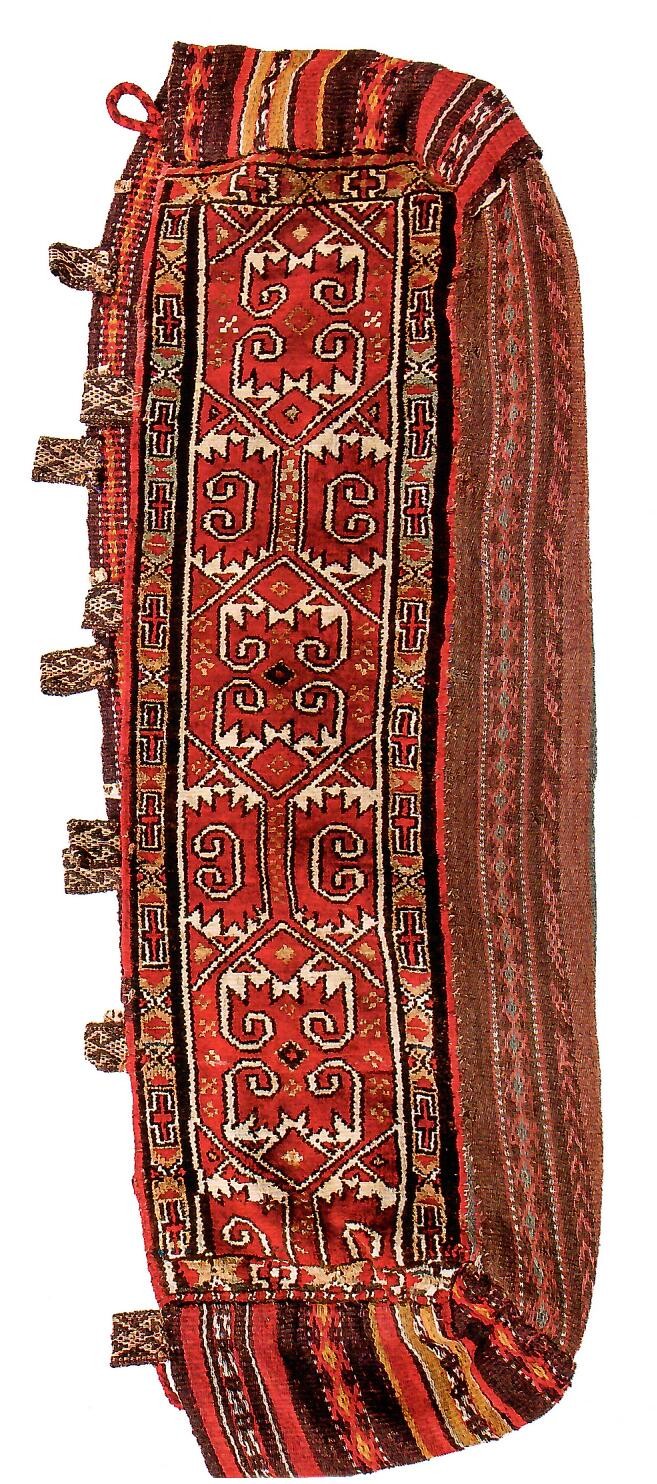
Bogzhama — a traditional rectangular cover designed for transporting and storing items. This specimen is distinguished by a combination of techniques: the front is made using the pile technique, whilst the reverse side and sides are sewn from two pieces of non-pile fabric.The composition of the front side is based on a carpet-weaving principle, with a central field and borders. The ornamentation is based on the sharshy pattern, within which ittaban motifs and zoomorphic elements are incorporated. The diamond-shaped structure of the sharshy symbolises an ordered space and fertility, whilst the ittaban (‘dog’s paw’) is traditionally interpreted as a protective symbol.