
Kebezhe
Aktobe Region. According to E.A. Masanov • Kebezhe. Wood, carving, painting. Central State Museum of Kazakhstan. • Kebezhe. Wood carving. Bone inlay. Early 20th century.
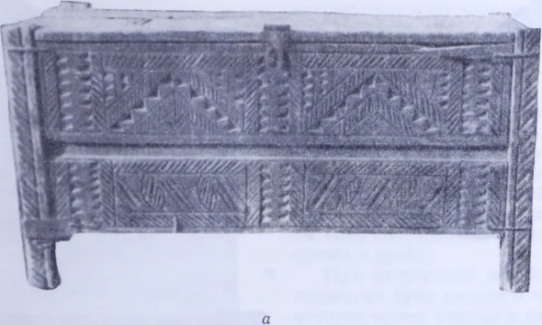
A kebezhe is a chest-like container with legs, used to store essential food supplies such as dried meat, kurta, etc. Chests were usually made of birch wood. In a kebezhe, as in a chest, the lid was opened by lifting it upwards or could be removed freely. The ornamentation on the side of the kebezhe facing the inside of the yurt varies: in the chest from E.A. Masanov’s expedition, it is two-level, with different two-part ornamentation motifs, united in a single rhythm by two vertical rows of border and a dividing strip repeating the pattern of the border stripes. The upper level of the ornamentation is decorated with stepped half-rhombus motifs, executed in the technique of triangular-notched geometric carving. The stepped rhombus motif is found in carpet weaving, and its semantic meaning is associated with the idea of fertility. The corner lines with the play of light and shadow of the triangular-notched carving repeat the parallel engraved lines with slanted strokes, creating a play of similarities. Ornamental motifs – slanted engraved parallel lines enclosed in border frames – in the lower tier serve as a visual contrast to the upper tier.The kebezhe from the Central State Museum of Art of Kazakhstan features a symmetrical central-axis composition with a circular vortex rosette in the middle, in which the blades alternate in colour. On both sides of the vortex rosette, symmetrical ornamental motifs are arranged along the horizontal axis: the dominant zoomorphic koshkar muiz – ram’s horns, from the top of which elements of a floral pattern with trefoils and tulip buds develop. The ornamental structures are closed by elements similar to koshkar muiz, but with a plant motif. A wooden roller around the perimeter of the kebezhe serves as a border. The warm yellow tone indicates a flat background, while the complementary grass-green colour dominates, creating a special energy of movement, and the contrasting pink colour creates a harmonious range of colour ratios. Floral petal rosettes with domes in the centre are placed at the corners and in the middle of the front side of the kebezhe. On the kebezhe, inlaid with bone by a master craftsman, a compositional carpet pattern is used with a border and a central field, inside which a strip is placed in the middle – a spacer, square rhombuses – sharshy– are highlighted with semicircular slats, inside which figured bone plates are placed perpendicularly. Floral rosettes are inserted in the middle of the rhombuses, secured with round nail heads. The slats are highlighted with contrasting colours: pink and grass green.