
Sholpy
20th century. Semipalatinsk Region. Silver, coins, carnelian, granulation, filigree. A. Kasteyev National Museum of Arts of the Republic of Kazakhstan
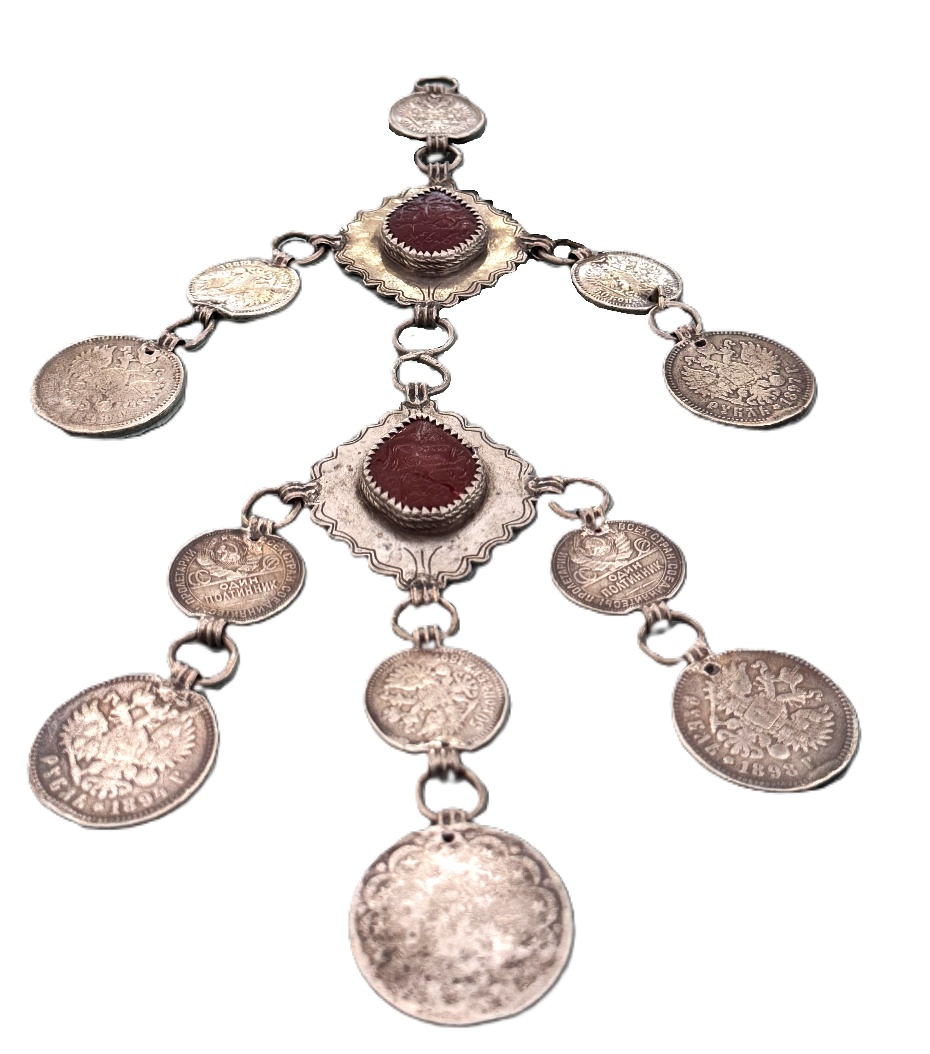
Sholpy, a pendant-style hair ornament. The item belongs to the category of traditional hair ornaments designed to be woven into braids, serving both decorative and protective functions. It is distinguished by a sophisticated suspension system and the extensive use of coin-like elements.The design comprises a central vertical composition of interconnected decorative plates with stone inlays. The upper part is fitted with a fastening element. Side chain branches with coin pendants extend from the central axis. The lower part is finished with a large disc-shaped element. All joints are hinged, ensuring the structure’s mobility.The composition is built on a vertical-axial principle with a pronounced tiered structure. The central line is formed by the sequential arrangement of plates with carnelian inlays, which serve as prominent compositional accents. The side pendants create a rhythmic expansion of the form, forming a complex, branched structure.The ornamental scheme is based on a combination of smooth stone surfaces and openwork filigree decoration. The metal plates are finished with a relief contour featuring a serrated edge, emphasising the shape of the inlays. Carnelian creates rich colour accents that contrast with the silver base. The coins serve a decorative and symbolic function, indicating status whilst simultaneously enhancing the piece’s dynamism.The suspended elements create a distinct sense of movement and produce an acoustic effect when in motion. Overall, the ornament demonstrates a combination characteristic of the East Kazakh tradition: a complex composition, a multi-tiered structure and decorative elements laden with symbolism.