
Earrings
East Kazakhstan. Silver, bent metal, coral. A. Kasteyev National Museum of Arts of the Republic of Kazakhstan
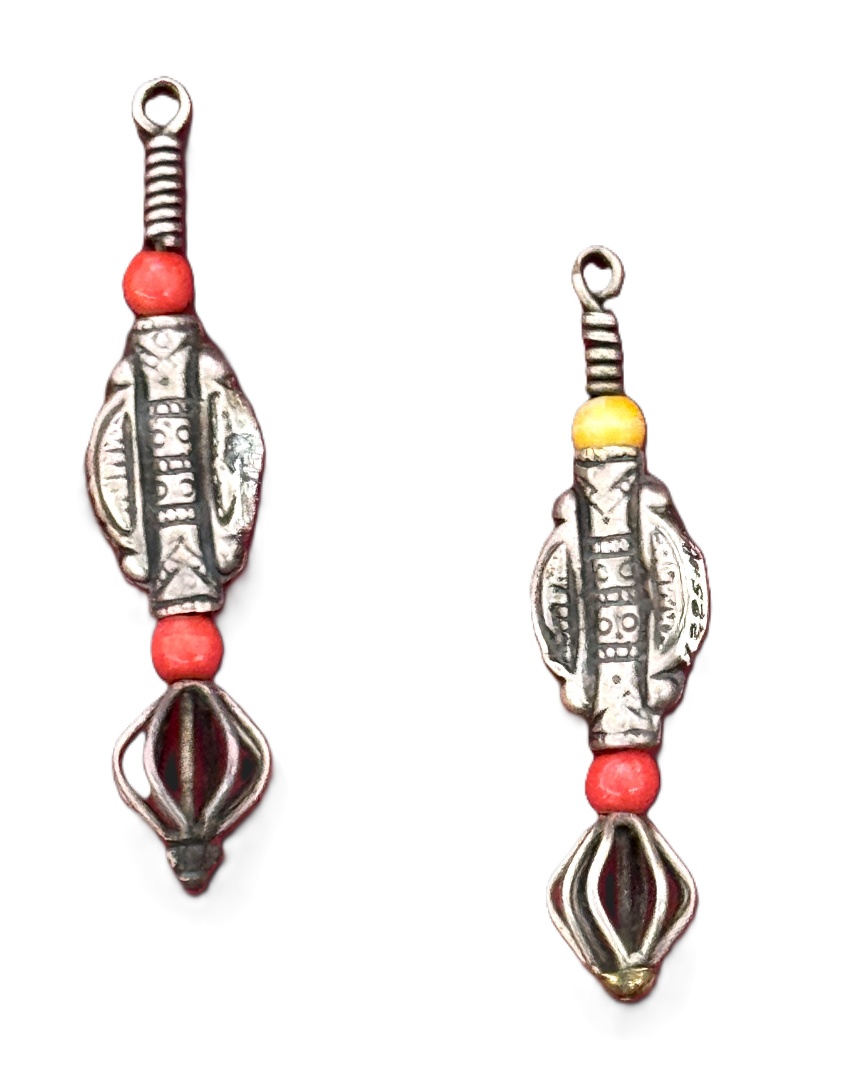
Syrga — linear-axial drop earrings characteristic of the East Kazakh tradition of jewellery art from the late 19th to early 20th centuries. The piece belongs to the category of everyday decorative forms and is distinguished by its compact vertical composition.The material is silver; decorative elements include coral inlays. The technique involves bending and relief work on the surface, which gives the elements their sculptural expressiveness.The design consists of a vertically oriented suspension system secured to a ring-shaped loop. The central element has an elongated cylindrical shape with lateral extensions. Coral beads are positioned at the top and bottom, serving as intermediate connecting elements. The composition is crowned by an openwork, three-dimensional teardrop-shaped pendant made of curved metal rods.The composition is structured according to a strict axial scheme with a sequential alternation of elements. The central part serves as the main visual focal point, whilst the coral inserts provide colour accents and rhythm. The lower openwork element completes the composition, lending it lightness and movement.The ornamental scheme combines geometric and stylised motifs. The decoration of the central element features linear and dot patterns that emphasise its form. The contrast between the silver surface and the bright coral inlays enhances the decorative expressiveness. The pendant element creates a sense of light movement and an acoustic effect characteristic of traditional jewellery of this type.