
Tumarsha
South Kazakhstan. Silver, gilding, granulation, filigree. A. Kasteyev National Museum of Arts of the Republic of Kazakhstan
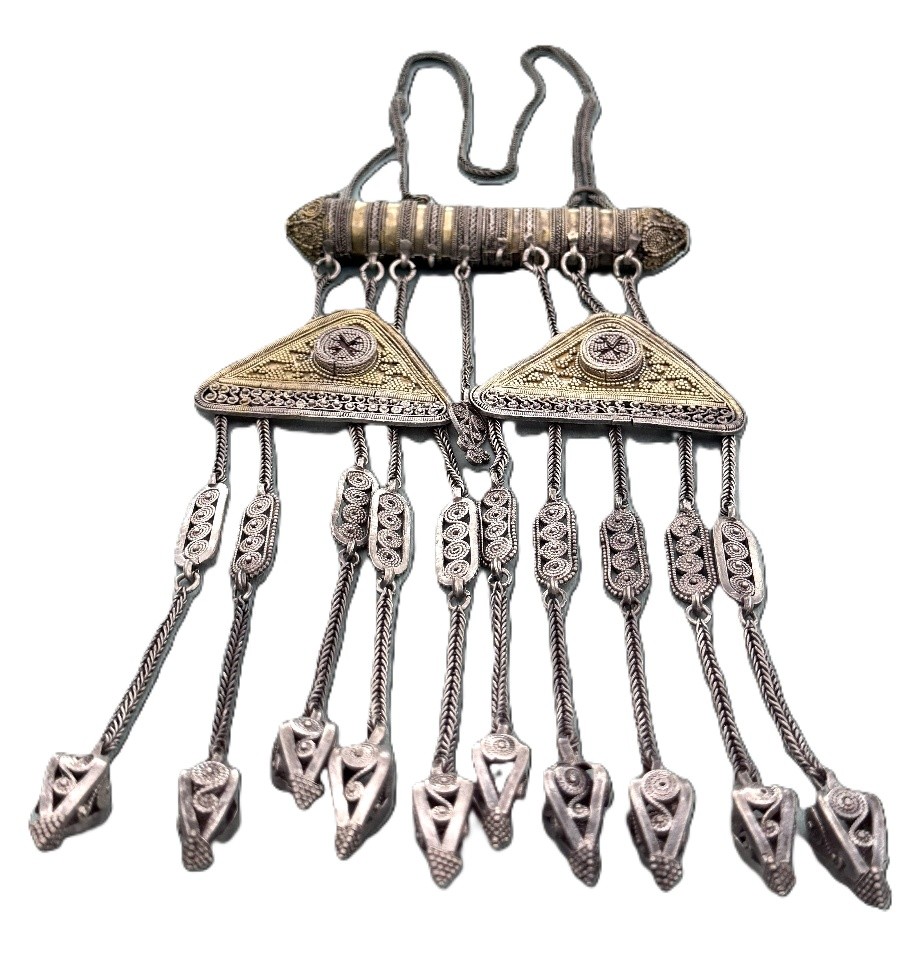
Tumarsha (paired amulets), a pendant-style neck and chest ornament. The piece belongs to the category of talismanic jewellery, which served a protective and status-symbol function as part of women’s attire. It is characterised by a complex, multi-component construction and pronounced decorative mobility.The design comprises a horizontal cylindrical element serving as the upper fastening, from which two triangular amulets (tumarsha) are suspended. Each amulet is complemented by a system of vertical chains with intermediate decorative elements and is finished with elongated pendants. All parts are connected by hinges, ensuring the mobility of the structure.The composition is based on a symmetrical axial principle. The central axis runs between the two amulets, forming a paired composition. The upper cylindrical element acts as a unifying link, whilst the lower section develops as a rhythmically organised system of pendants. The alternation of large and small elements creates a complex rhythm and enhances the visual dynamism.The ornamental scheme combines geometric and spiral motifs. The surfaces of the triangular amulets are decorated with filigree ornamentation featuring central rosette elements. The pendants are executed in the scani technique, forming openwork spiral compositions. Grain decoration emphasises the contours and enhances the textural richness of the surface. Gilding highlights individual elements and creates a colour contrast.The pendant elements serve a decorative and acoustic function, creating movement and a sound effect when worn. Overall, the piece demonstrates a combination characteristic of the South Kazakh tradition: a complex structure, paired symbolism and pronounced talismanic semantics.