
Bilezik
Southern Kazakhstan. Silver, glass, gilding, engraving, casting, filigree, stamping. A. Kasteyev National Museum of Arts of the Republic of Kazakhstan
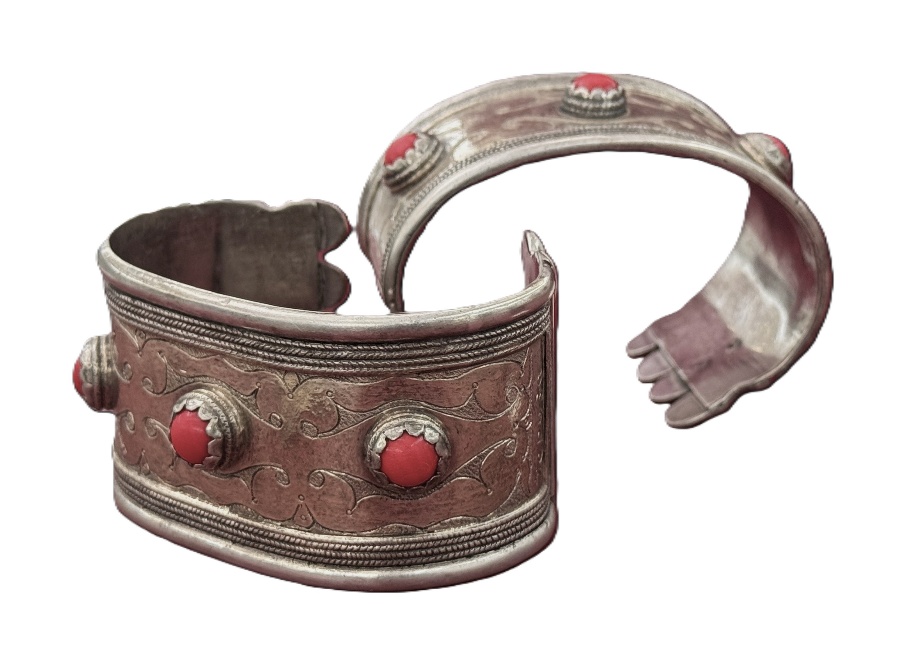
A bilezik is a cuff-style wrist ornament characteristic of the South Kazakh tradition of jewellery art in the 20th century. The piece belongs to the category of ceremonial jewellery and served a decorative and status-symbol function as part of women’s attire.The material is silver with gilding; the decorative inlays are made of coloured glass. The techniques used include casting, engraving, stamping and filigree. The combination of various techniques creates a complex ornamental and sculptural surface structure.The design consists of a wide, open cuff-style bracelet base with a gently curved profile. The ends of the piece are flared and feature a curved shape, which makes it easier to put on whilst also serving as a decorative finish. The central section is reinforced by overlay elements with inlays.The composition is arranged in a frieze-like pattern, with a central ornamental band highlighted. The main field is decorated with a flowing floral ornamentation in the form of scrolls and tendrils, creating a continuous rhythm. Along the central axis are rounded red glass inserts, set in castings with serrated frames, creating striking colour accents.The ornamental scheme combines plant motifs with elements of linear ornamentation. The red inserts play a key role in the composition, establishing a rhythm and enhancing the decorative expressiveness of the piece. The contrast between the warm tone of the gilding, the cool sheen of the silver and the rich colour of the inserts lends the ornament visual richness and emphasises its ceremonial character.