
Yuzik
East Kazakhstan. Silver, repoussé, blackening, engraving. A. Kasteyev National Museum of Arts of the Republic of Kazakhstan
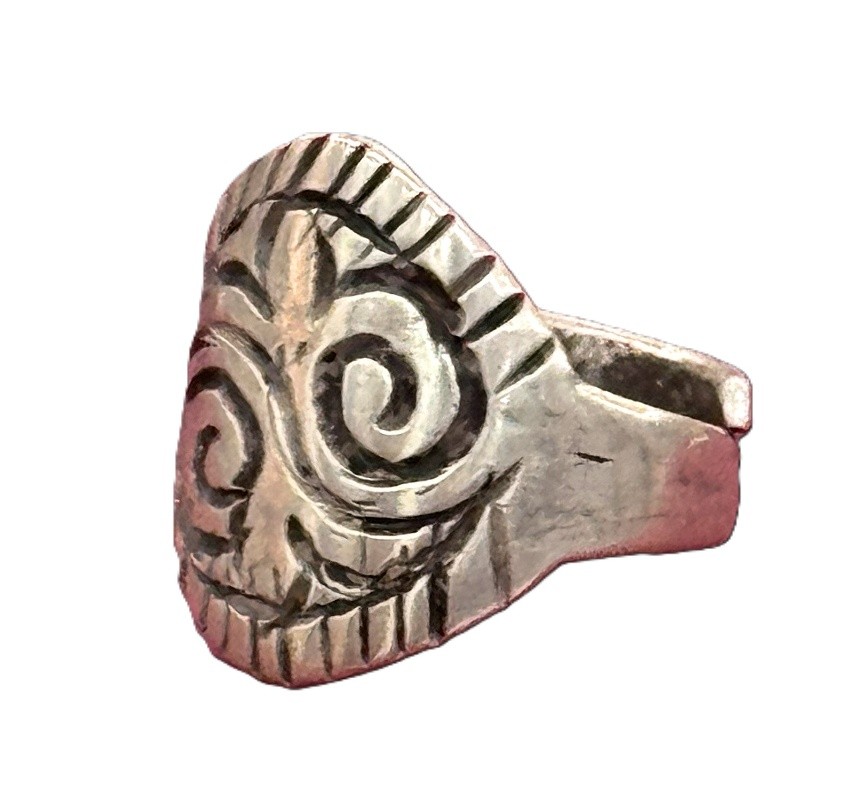
Ring (juzik) with a relief shield featuring a floral ornament. The ring belongs to the category of traditional everyday decorative jewellery, in which the main emphasis is on the plasticity of form and the expressiveness of the ornamentation.The design comprises a solid shank widening at the top, transitioning into an oval-triangular shield. The shield is slightly raised above the base and has a thickened edge with rhythmic notches forming a framing band. The surface of the piece is solid metal, without inlays.The composition is organised along a central axis. The main volume is concentrated in the upper part, where a relief ornamental motif is situated. The shield is arranged as a single field without division into segments, which lends the composition a sense of unity and monumentality.The ornamental scheme is based on a stylised plant motif with characteristic spiral curls, harking back to traditional horn-shaped (‘koshqar muiz’) forms. The relief decoration is executed using the repoussé technique, followed by blackening of the recesses, which enhances the graphic quality of the design and the contrast between light and shadow.Overall, the piece demonstrates a tendency characteristic of the East Kazakh tradition towards a concise structural solution whilst retaining expressive ornamental plasticity, where decorativeness is achieved through the depth of the relief and the clarity of the silhouette.