
Kapsyrma
North Kazakhstan. Silver, engraving, embossing, blackening, stamping. A. Kasteyev National Museum of Arts of the Republic of Kazakhstan
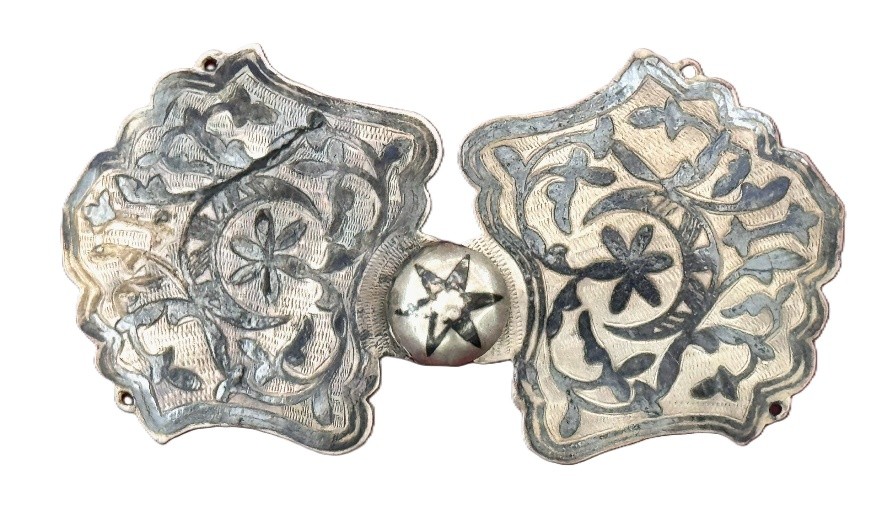
Kapsyrma (Clasp). The item is a belt fastening and serves both a utilitarian function of securing the belt or garment and a distinct decorative and representational role. Structurally, it consists of two symmetrical halves joined by a central locking mechanism.The composition is based on the principle of mirror symmetry: each panel has a curved outline with softly defined edges, forming a unified decorative silhouette when closed. The central clasp is accentuated by a convex, spherical element with an engraved star-shaped motif, serving as the compositional and functional centre.The ornamental design features botanical motifs — stylised shoots, leaves and floral elements — arranged in a dynamic yet balanced composition. The use of blackening enhances the contrast between the design and the background, lending the ornamentation graphic clarity and depth.Technologically, the piece demonstrates the combined use of repoussé and stamping to create the relief, engraving to refine the details, and blackening to accentuate the ornamental lines.Overall, the clasp reflects the enduring tradition of North Kazakh jewellery art, where structural function is organically integrated into the artistic form, and symmetry and ornamentation serve as key means of visual expression.