
‘Before the Solar Eclipse’, 2009
Almagul Menlibayeva • Photograph. Hahnemühle Photo Rag paper, inkjet print. 71 × 107
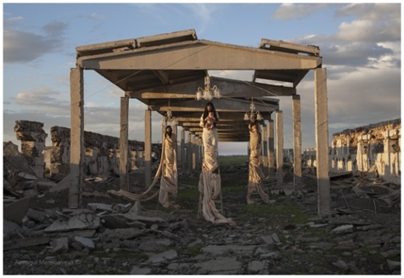
Photography is considered a popular contemporary form of new media. The title of Almagul Menlibayeva’s photograph is metaphorical and may be linked to myths from various cultures around the world concerning the disappearance of the sun: people believed that the sun was swallowed by monsters, or that this was a manifestation of a deity’s wrath. The textual discourse of the photograph’s title evokes real traumatic events from the historical past of the Soviet Union, when over a million citizens were imprisoned in Karlag—one of the camps in the Gulag system—on various charges brought by the totalitarian regime. At the centre of the photograph’s composition stands a bare, time-worn structure of a post-and-beam system, with separate vertical supporting columns and triangular pediments, evoking visual imagery of ancient Greek architecture. The building’s measured segments, repeating in an enfilade to infinity, stretch towards the vanishing point, testifying to the scale of the violence. On either side of the building, the ruins of crumbling concrete walls are depicted, reinforcing the artist’s deeply unsettling conceptual framework. The three female figures symbolise support and resilience in life, and they are reminiscent of ancient Greek caryatids. The solitary chandeliers hanging above their heads against the backdrop of a cold sky are perceived as a lost symbol of Home. The figures stand on staged staircases , as if on pedestals, but the symbolism of the staircases is linked to many concepts, including spiritual elevation. The central figure evokes images of the Madonna in art; in this case, the ‘Steppe Madonna’ – a symbol of resilience and the rebirth of life in the face of all tragic events.
Source: Almaty Museum of Arts