Traditional and contemporary art of Kazakhstan

A Virtual Journey into the World of Kazakhstan’s Artistic Heritage

This Web Gallery presents the diversity of artistic practices in Kazakhstan, reflecting the continuity of cultural traditions and the dynamic development of contemporary creative processes. The virtual exhibition features works based on national images, symbols, and themes, as well as artworks by contemporary artists who reinterpret the country’s cultural heritage through contemporary artistic forms, expressive means, and modern technologies.

The selected works demonstrate the relationship between traditional and contemporary art, revealing the distinctive features of the national worldview, cultural identity, and cultural meanings. The presented materials allow viewers to trace how elements of historical and cultural heritage are reflected in contemporary artistic practice, while maintaining their significance and relevance in an increasingly globalized world.

The Web Gallery is aimed at promoting Kazakhstan’s artistic heritage, expanding public access to works of art, and fostering a lasting interest in national culture and art among a wide audience.

Syrmak, 2010. N.S. Aspombitova

Almaty Region. • Syrmak, 1960. Felt, felting, inlay, decorative stitching, appliqué of decorative cord. • From the collection of the A. Kasteev National Museum of Arts of the Republic of Kazakhstan (72-b).
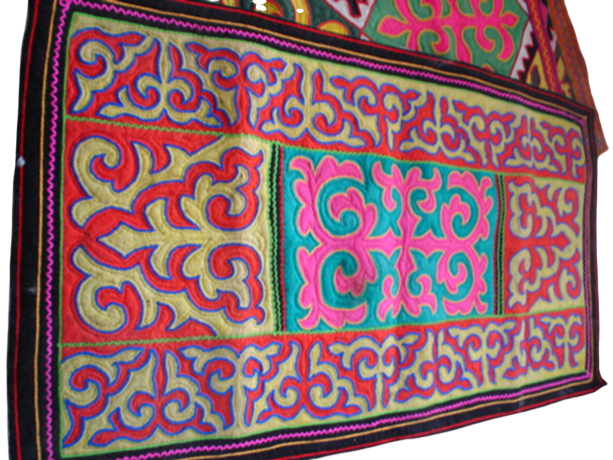
The composition is structured around a clear division into a central field and a wide border: the central section is set against a contrasting green background, upon which an intricate symmetrical ornament is depicted. The ornamental motifs are of a floral and zoomorphic nature and derive from traditional ‘muyiz’ forms, transformed into tree-like and plant-like scrolls and spirals. The border is decorated with large repeating elements, which enhance the decorative unity of the piece and create a clear visual frame. The colour scheme of the syrmak is characterised by high decorative saturation and contrast: bright combinations of red, yellow and green, typical of the felt appliqué technique, dominate. The clear outline of the ornament and its three-dimensional expressiveness are achieved through the layering of coloured sections and the precise cutting of elements, which testifies to the artist’s high level of skill.