
Fragment of a vessel. Kayalyk settlement
From the book: The Artistic Culture of Central Asia and Azerbaijan, 9th–15th Centuries. Volume II. Glass. — Samarkand-Tashkent: MICAI, 2011.
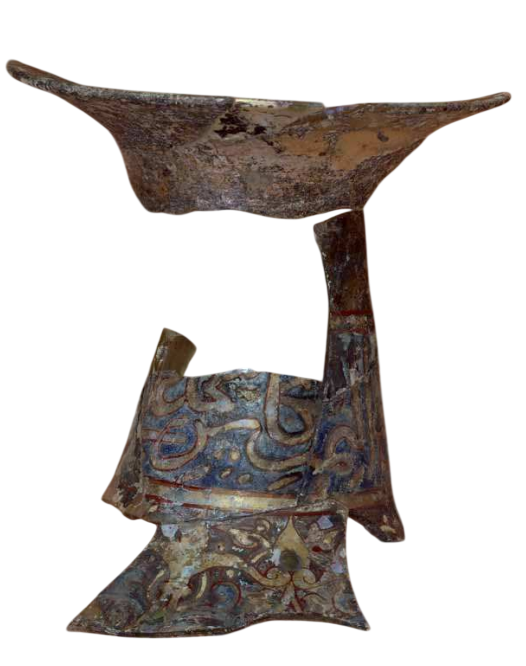
Before us are fragments of a cup-shaped vessel, executed using the complex technique of painting with coloured enamels and gilding.The decorative composition is organised according to a register-based principle. In the central section, a wide horizontal band stands out, bearing a calligraphic inscription, likely executed in one of the varieties of Arabic script. Such epigraphic friezes traditionally contained auspicious phrases (‘happiness’, ‘prosperity’, ‘longevity’) or texts glorifying the owner or patron of the piece. The inscription not only conveys meaning but also serves as an important decorative element, setting the rhythm of the entire composition.The rich blue (lapis lazuli) background serves as a contrasting backdrop for the inscriptions executed in gold. In the lower section, an exquisite arabesque ornament can be seen—a complex interweaving of stems and stylised leaves.