
Wall alasha carpet, second half of the 20th c.
2nd half of the 20th century. Turkestan Region. Collection of the Central State Museum of the Republic of Kazakhstan
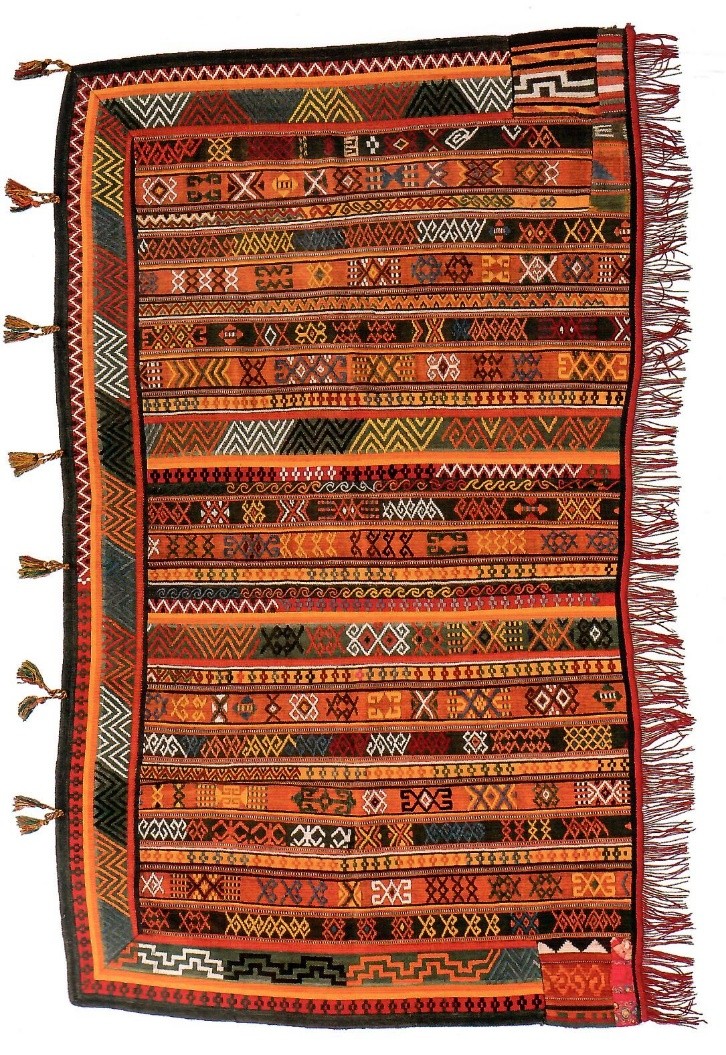
This unique example of a traditional Kazakh tusalasha consists of thirteen woven strips sewn together, made from threads of white, black, yellow, blue, red, green and brown. The piece was created using the complex terme technique, which allows for the creation of a clear, graphic ornament.The composition is based on the rhythmic alternation of strips decorated with the patterns kos muyiz, tolqyn, irek, shynzhara, orkesh and bes tangba (Catalogue, 210). Each of these motifs has a well-established meaning within the system of traditional Kazakh ornamentation: kos muyiz (‘paired horn’) – one of the oldest zoomorphic symbols, associated with the image of strength, abundance and prosperity; tolqyn and irek (wave-like elements) – images of water, movement and the flow of life; shynzhara (‘chain’) – a symbol of the continuity of the lineage and the connection between generations; orkesh (‘camel hump’) – a sign of prosperity, stability and the steppe environment; bes tanba (‘five signs’) – a motif often interpreted as a family or protective symbol.The ornamental composition of this tusalasha seems to echo the most ancient artefacts – the patterns of Andronovo pottery from the Andronovo culture. Geometric forms, clear rhythm and the predominance of linear motifs demonstrate the continuity of artistic traditions rooted in the Bronze Age.Thus, the piece serves not only as a decorative element of the interior, but also as a unique ‘text’ of culture, in which the memory of the ancient worldviews and artistic canons of the steppe civilisation is preserved.