Traditional and contemporary art of Kazakhstan

A Virtual Journey into the World of Kazakhstan’s Artistic Heritage

This Web Gallery presents the diversity of artistic practices in Kazakhstan, reflecting the continuity of cultural traditions and the dynamic development of contemporary creative processes. The virtual exhibition features works based on national images, symbols, and themes, as well as artworks by contemporary artists who reinterpret the country’s cultural heritage through contemporary artistic forms, expressive means, and modern technologies.

The selected works demonstrate the relationship between traditional and contemporary art, revealing the distinctive features of the national worldview, cultural identity, and cultural meanings. The presented materials allow viewers to trace how elements of historical and cultural heritage are reflected in contemporary artistic practice, while maintaining their significance and relevance in an increasingly globalized world.

The Web Gallery is aimed at promoting Kazakhstan’s artistic heritage, expanding public access to works of art, and fostering a lasting interest in national culture and art among a wide audience.

Fragment of a towel 20th c.

Collection of the State Museum of the Republic of Kazakhstan. 71-tk. First half of the 20th century. Taldykorgan Region • Folk artist Maria Bilyalova • Silk, sequins, coloured threads, tambour stitch
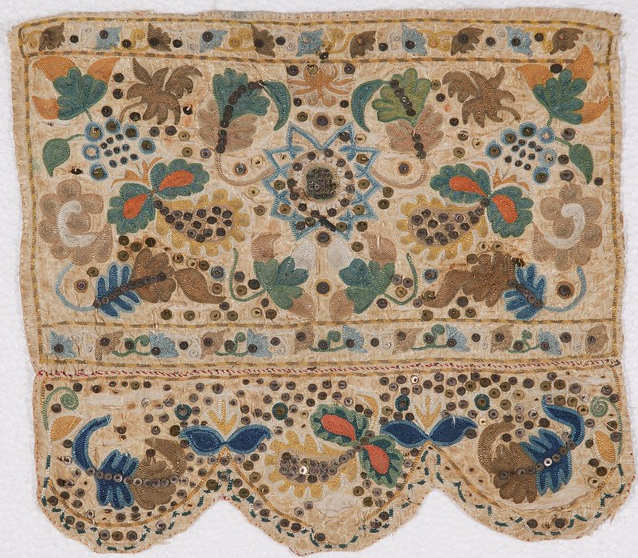
The item shown is a fragment of a towel. It is made of light-coloured fabric and decorated with rich embroidery using coloured threads. The lower edge has a scalloped shape, lending the item a distinctive decorative quality.The composition is based on horizontal division and symmetry. The main part of the towel is filled with an ornamental composition, the centre of which is a star-shaped medallion. Plant motifs radiate symmetrically from it, forming a balanced ornamental structure.The lower part of the piece is adorned with a separate decorative band featuring a scalloped edge. Each scallop contains stylised floral elements, which are repeated in a rhythmic sequence.The ornamental elements are combined with numerous decorative dot motifs, which enhance the rhythm of the composition and create a rich surface texture. The colour scheme is characterised by soft polychromy.