Traditional and contemporary art of Kazakhstan

A Virtual Journey into the World of Kazakhstan’s Artistic Heritage

This Web Gallery presents the diversity of artistic practices in Kazakhstan, reflecting the continuity of cultural traditions and the dynamic development of contemporary creative processes. The virtual exhibition features works based on national images, symbols, and themes, as well as artworks by contemporary artists who reinterpret the country’s cultural heritage through contemporary artistic forms, expressive means, and modern technologies.

The selected works demonstrate the relationship between traditional and contemporary art, revealing the distinctive features of the national worldview, cultural identity, and cultural meanings. The presented materials allow viewers to trace how elements of historical and cultural heritage are reflected in contemporary artistic practice, while maintaining their significance and relevance in an increasingly globalized world.

The Web Gallery is aimed at promoting Kazakhstan’s artistic heritage, expanding public access to works of art, and fostering a lasting interest in national culture and art among a wide audience.

Beshmet, 19th c.

Ural region. Mid-19th century. Belonged to Khan’s wife Fatima, wife of Zhangir, Khan of the Bukeev Horde. Collection of the Central State Museum of the Republic of Kazakhstan
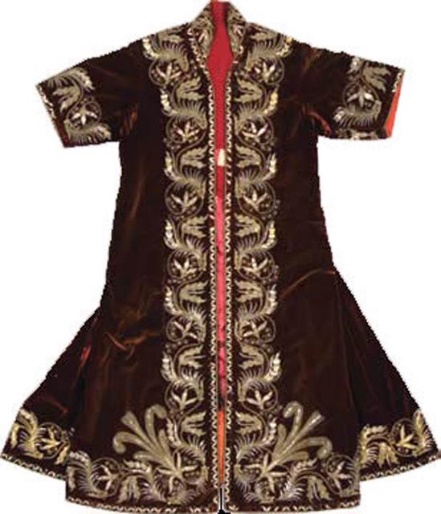
The beshmet is a fitted outer garment with short sleeves and a flared lower section. The garment is made of dark velvet. Its design features a vertical slit at the front and a defined silhouette.The main artistic feature is the rich embroidery in gold thread covering the front panels, sleeves and hem of the garment. The ornamental composition is arranged symmetrically about the central line. A vertical decorative band runs along the front slit, from which large floral patterns unfold on both sides. The ornamentation consists of stylised flowers, leaves and flowing scrolls, forming a rhythmic and harmonious pattern.The embroidery is executed with dense stitches, giving the pattern a three-dimensional quality and decorative expressiveness.The colour scheme is based on the contrast between the dark velvet background and the golden embroidery. This combination is characteristic of the ceremonial attire of the Kazakh aristocracy and emphasises the high social status of the owner.