Traditional and contemporary art of Kazakhstan

A Virtual Journey into the World of Kazakhstan’s Artistic Heritage

This Web Gallery presents the diversity of artistic practices in Kazakhstan, reflecting the continuity of cultural traditions and the dynamic development of contemporary creative processes. The virtual exhibition features works based on national images, symbols, and themes, as well as artworks by contemporary artists who reinterpret the country’s cultural heritage through contemporary artistic forms, expressive means, and modern technologies.

The selected works demonstrate the relationship between traditional and contemporary art, revealing the distinctive features of the national worldview, cultural identity, and cultural meanings. The presented materials allow viewers to trace how elements of historical and cultural heritage are reflected in contemporary artistic practice, while maintaining their significance and relevance in an increasingly globalized world.

The Web Gallery is aimed at promoting Kazakhstan’s artistic heritage, expanding public access to works of art, and fostering a lasting interest in national culture and art among a wide audience.

Tabaq

B. Mailin History and Local Lore Museum (Kostanay Region)
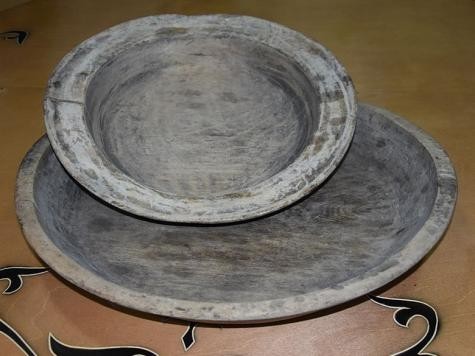
Traditional Kazakh wooden tableware includes dishes for lamb meat, known as tabak. These are round dishes with straight or sloping sides, wide rims and flat bottoms. Sometimes they were very large. E.A. Masanov mentions in his study bowls that could hold the meat of a whole sheep (Masanov, p. 47). These dishes were most often made by turning, a manual method described by E.A. Masanov (Masanov, p. 48), so their main artistic merits were their harmonious proportions of diameter, rim width and depth. Only well-dried and boiled wood – birch or oak in one piece – was used to make the dishes. The dishes differed in their basic dimensions, names and functional purposes: they were used in accordance with established centuries-old traditions of receiving guests or family members and prepared with different parts of animal carcasses, a process called tabak tartu.