
Ukiayaq
Kostanay Region. Silver, eagle owl claws, carnelian, coral, glass, coins, granulation, twisted wire. A. Kasteyev National Museum of Arts of the Republic of Kazakhstan
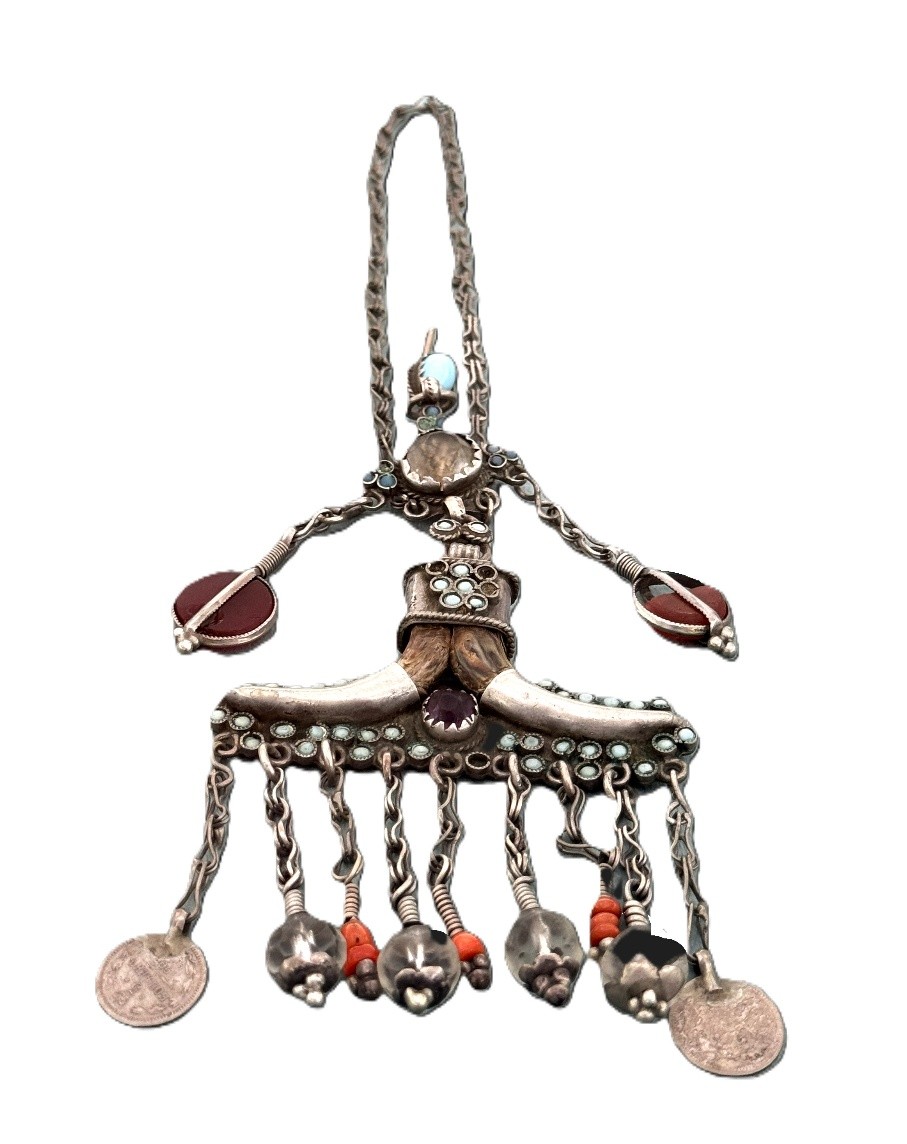
Ukiayak, amulet pendant (chest ornament with zoomorphic elements). The artefact belongs to the category of complex-structured neck and chest amulets, combining decorative and pronounced sacred functions.The design features an upper suspension node with a chain, from which side branches extend with disc-shaped pendants. The central part is accentuated by a three-dimensional element with a stone inlay and decorative overlays. Below this lies the main horizontal element, complemented by zoomorphic details — eagle owl claws set in a metal frame. The lower section is finished with a system of pendants comprising chains, spherical elements, coral inlays and coins. All parts are connected in a movable manner.The composition is structured along an axial principle with a developed tiered structure. The upper part forms the suspension point, the middle part the compositional core, and the lower part the zone of active decorative development. The horizontal element with claws serves as the visual anchor of the entire composition, from which a rhythmic system of pendants extends downwards.The ornamental system combines geometric, botanical and zoomorphic motifs. Central inserts of stone and glass create colour accents, whilst the grain-like decoration emphasises the contours and enhances the textural richness of the surface. Of particular significance are the eagle owl’s talons, which possess distinct amuletic symbolism and are associated with protection against evil forces.The suspended elements create a dynamic effect and produce a sound when in motion. Overall, the piece is a striking example of the synthesis of jewellery art and magical-ritual practice, where the decorative complexity of the form is directly linked to its protective function.