
Bilezik
South Kazakhstan. Silver, engraving, casting. A. Kasteyev National Museum of Arts of the Republic of Kazakhstan
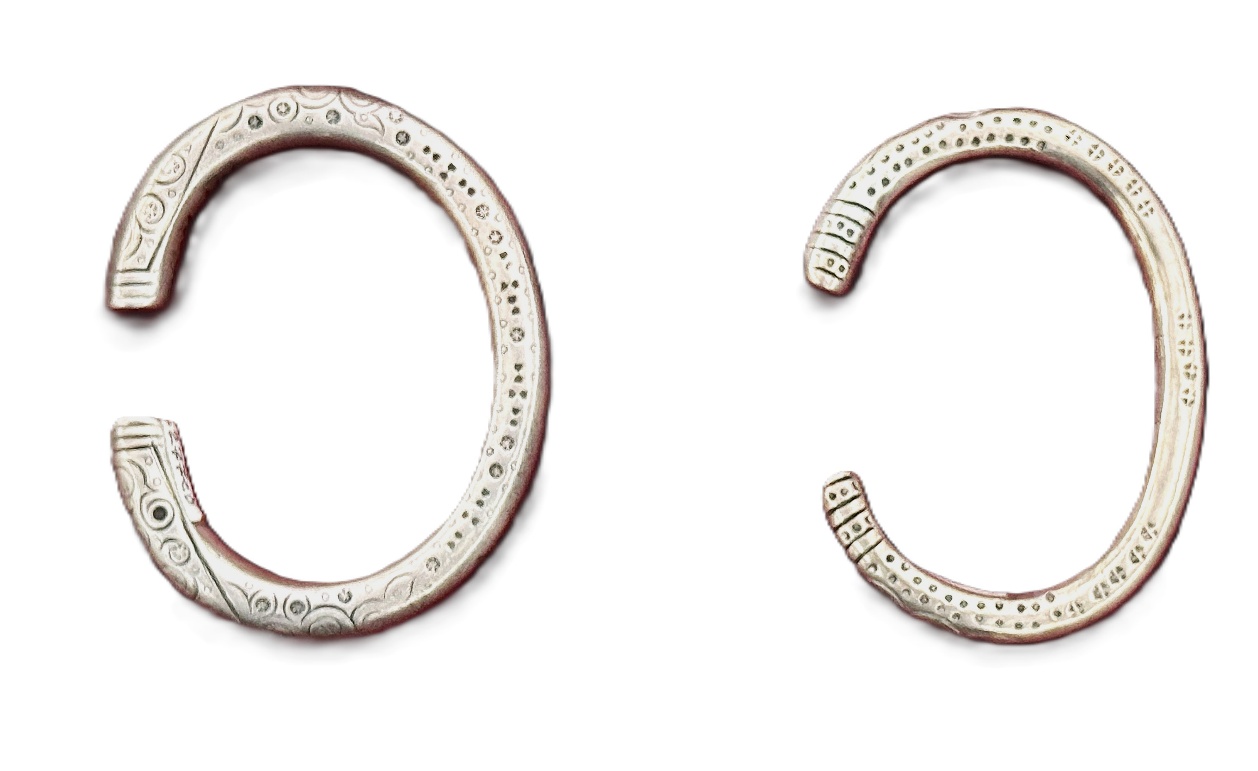
A Bilezik is an open-ring-type wrist ornament characteristic of the South Kazakh tradition of jewellery art in the 20th century. The piece belongs to the more minimalist forms of jewellery and served primarily an everyday decorative function.The material is silver; the techniques used include casting and engraving. The absence of inlays and additional applied elements draws attention to the shape of the piece and the quality of the ornamental surface treatment.The design consists of a smooth, round-sectioned ring-shaped base with open ends. The ends are shaped as thickened, slightly profiled terminations, which make the piece easier to put on whilst also serving as a decorative accent. The form is characterised by its compactness and functional simplicity.The composition follows the contour of the piece and is linear in nature. The ornamentation is evenly distributed across the entire surface and has no distinct centre. The decoration consists of an alternation of engraved dots, lines and simple geometric elements, arranged in a rhythmic sequence.The ornamental system is characterised by restraint and conciseness. The motifs used—dots, short lines, arched and wavy elements—form a continuous ornamental band. This decorative scheme emphasises the form’s structure and reflects a long-standing tradition of minimalist jewellery design, where primary importance is attached to the purity of the silhouette and the rhythm of the pattern.