
Kudagi yuzik
West Kazakhstan. Silver, glass, gilding, granulation, stamping, granulation. A. Kasteyev National Museum of Arts of the Republic of Kazakhstan
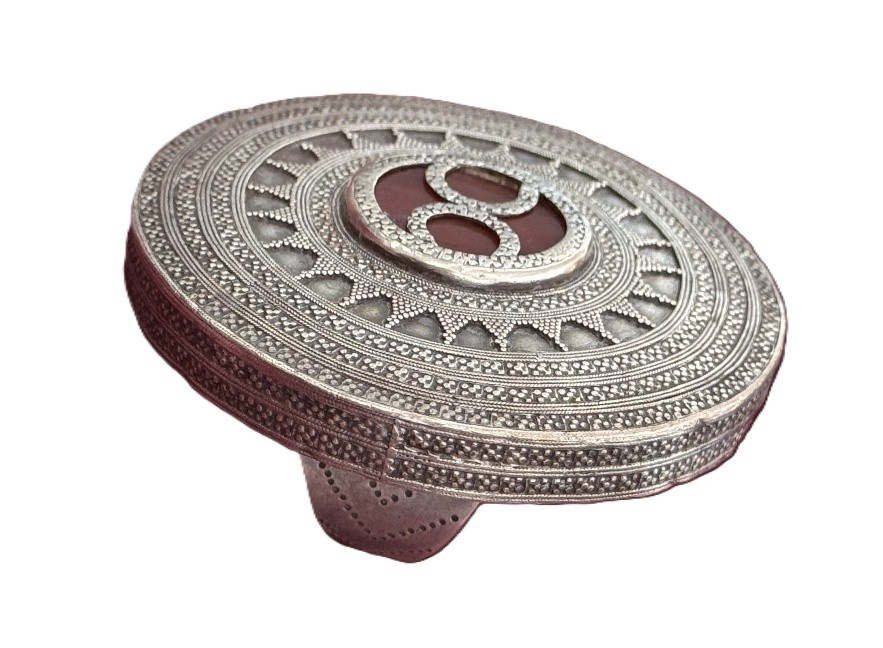
Ring (juzik), ‘kudagi juzik’ type (matchmaker’s ring). The ring belongs to the category of ceremonial women’s jewellery of a ritual and status-related nature, associated with the system of kinship and marriage relations. It is distinguished by its large scale and pronounced decorative representativeness.The design comprises a solid shank that transitions into a significantly widened oval-disc-shaped shield, raised above the base. The shield has a multi-layered structure with a pronounced rim, decorated with ornamental bands. The central part is accentuated by an insert of coloured glass, set in a cast and complemented by an overlay element.The composition is built on a concentric principle with a clearly defined centre. A system of concentric ornamental bands is arranged around the central insert, comprising alternating smooth and grained areas. One of the bands is decorated with radially directed elements, creating the effect of a ray-like spread of the form. The periphery of the shield is emphasised by a dense ornamental border, forming a self-contained composition.The ornamental scheme combines geometric and solar-symbolic motifs. The central element, with its applied figure and coloured inlay, serves as the conceptual core, whilst the concentric bands with granulated decoration enhance the effect of multi-layered structure and rhythmic organisation. The use of gilding and a glass inlay creates a colour contrast and emphasises the status of the artefact.Overall, the ring demonstrates a striving for monumental form, rich textural detail and complex compositional organisation characteristic of the West Kazakh tradition, reflecting the high social significance of the ornament.