
Kudagi zhuzik Location: Astana, Water and Green Boulevard Source: E. V. Rybnikova’s website
Qudagi zhuzik
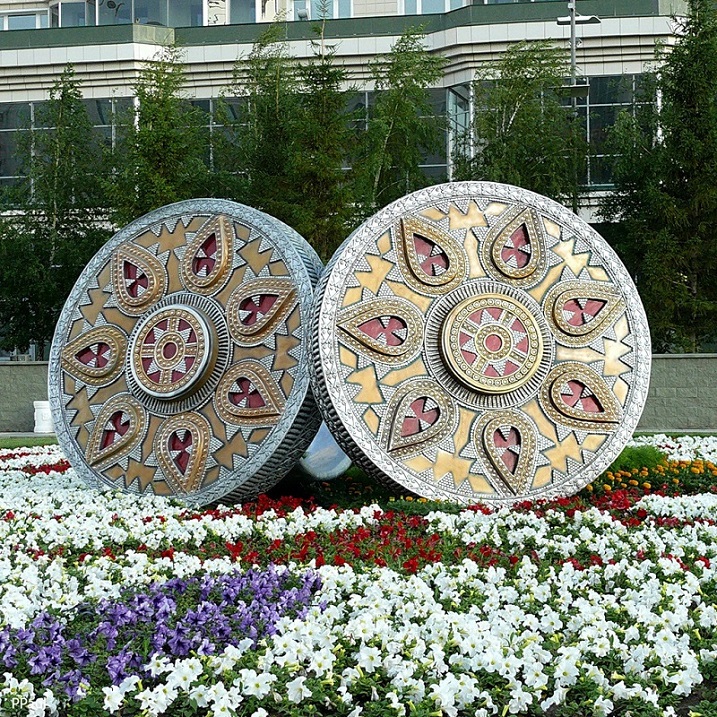
The key to interpreting the work lies in its connection with a traditional Kazakh women’s ornament — the qudagı zhuzik (matchmaker’s ring). In Kazakh culture, this object holds special social and symbolic significance that extends far beyond its decorative function.Traditionally, the qudagı zhuzik was presented by the bride’s mother to the groom’s mother some time after the wedding. Such a gift was a token of gratitude and signified that the young woman had found respect, care and dignified treatment within her new family. In this way, the piece of jewellery served as tangible confirmation of the successful establishment of kinship ties between the two families.Translating the form of a piece of jewellery into the scale of an urban sculpture significantly broadens the range of its interpretative meanings. In this monumental interpretation, the structural elements of the ring take on architectural expressiveness: the cylindrical base is perceived as an enlarged shank of the jewellery, whilst the two large disc-shaped forms are seen as decorative shields, forming the compositional centre of the work.This scaling shifts the work from the realm of personal and family symbolism into the sphere of collective memory and social values. Whilst in traditional culture the ring served as a symbol of agreement between two families, in the context of the urban environment it becomes a metaphor for unity, mutual understanding and social harmony.