
Day and Night, 2023. Tapestry, weaving. Source: https://www.ounce.group
Kundyz Zhilibaeva
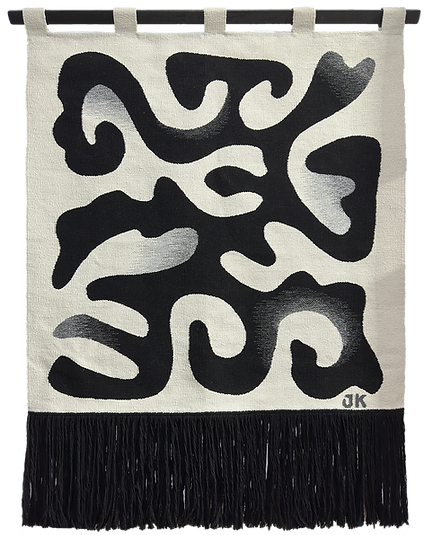
This is a philosophical exploration of the idea of dualism, expressed through the medium of contemporary textile art. The artist addresses the universal theme of the interplay between opposites — light and darkness, day and night, presence and absence — translating it into the language of abstract composition and the rhythmic interplay of form and space.The artistic concept is based on the contrast between black and white. There is no clear distinction between background and figure in the work: black and white interpenetrate one another, creating an effect of fluidity and constant transformation. This visual ambiguity evokes a sense of the cyclical nature of time and emphasises the idea of an inseparable connection between opposing principles. In this context, the composition can be interpreted as a visual metaphor for cosmic equilibrium.The flowing biomorphic lines lend the composition an organic quality and an inner dynamism. Their form may be associated both with natural structures — the flow of water, clouds, the contours of the landscape — and with transformed elements of the traditional ‘qoshqar muiz’ ornament. However, the artist elevates the ornamental basis to a level of near-complete abstraction, transforming the ethno-cultural motif into a universal visual symbol of rhythm and continuous movement.