Traditional and contemporary art of Kazakhstan

A Virtual Journey into the World of Kazakhstan’s Artistic Heritage

This Web Gallery presents the diversity of artistic practices in Kazakhstan, reflecting the continuity of cultural traditions and the dynamic development of contemporary creative processes. The virtual exhibition features works based on national images, symbols, and themes, as well as artworks by contemporary artists who reinterpret the country’s cultural heritage through contemporary artistic forms, expressive means, and modern technologies.

The selected works demonstrate the relationship between traditional and contemporary art, revealing the distinctive features of the national worldview, cultural identity, and cultural meanings. The presented materials allow viewers to trace how elements of historical and cultural heritage are reflected in contemporary artistic practice, while maintaining their significance and relevance in an increasingly globalized world.

The Web Gallery is aimed at promoting Kazakhstan’s artistic heritage, expanding public access to works of art, and fostering a lasting interest in national culture and art among a wide audience.

Time and Space, 2022. Canvas, acrylic. From the artist’s personal archive

Kaboke Oralbek
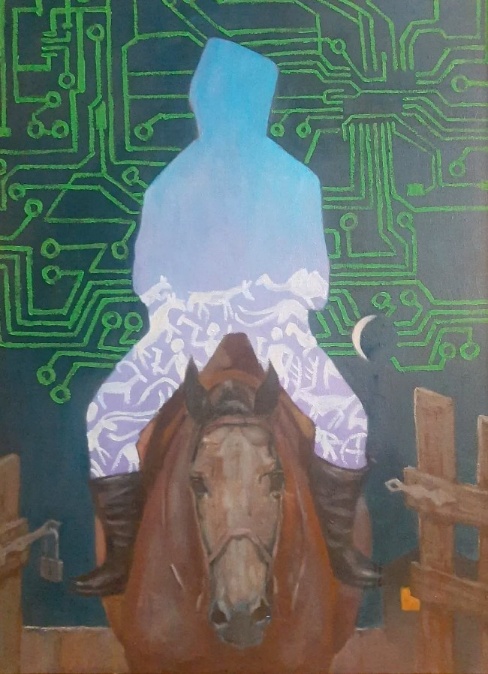
The painting ‘Time and Space’ conceptually addresses the question of time and space through the paradox of the enduring nature of traditional symbols across successive cultural and civilisational eras. The figure of the horseman is silhouetted, with mountain peaks visible against a blue sky in the outline of his form. The ‘looking through’ technique enhances the dynamics of space, which contributes to the visual sensation of a transition into another space-time.In contrast to the horseman, the horse is depicted in a practically realistic manner, its gaze fixed on the viewer. Against a dark background is an electronic circuit diagram, symbolising the new information space as a labyrinth of lost meanings. Metaphorical text – this is how one might describe the artistic language of this painting as a whole, in which the symbol of the nomadic world is not illusory, unlike modernity, which is expressed in the conventional language of diagrams devoid of human meaning.