Traditional and contemporary art of Kazakhstan

A Virtual Journey into the World of Kazakhstan’s Artistic Heritage

This Web Gallery presents the diversity of artistic practices in Kazakhstan, reflecting the continuity of cultural traditions and the dynamic development of contemporary creative processes. The virtual exhibition features works based on national images, symbols, and themes, as well as artworks by contemporary artists who reinterpret the country’s cultural heritage through contemporary artistic forms, expressive means, and modern technologies.

The selected works demonstrate the relationship between traditional and contemporary art, revealing the distinctive features of the national worldview, cultural identity, and cultural meanings. The presented materials allow viewers to trace how elements of historical and cultural heritage are reflected in contemporary artistic practice, while maintaining their significance and relevance in an increasingly globalized world.

The Web Gallery is aimed at promoting Kazakhstan’s artistic heritage, expanding public access to works of art, and fostering a lasting interest in national culture and art among a wide audience.

Terme alasha, 20th c.

2nd half of the 20th century. Shymkent. Collection of the Central State Museum of the Republic of Kazakhstan
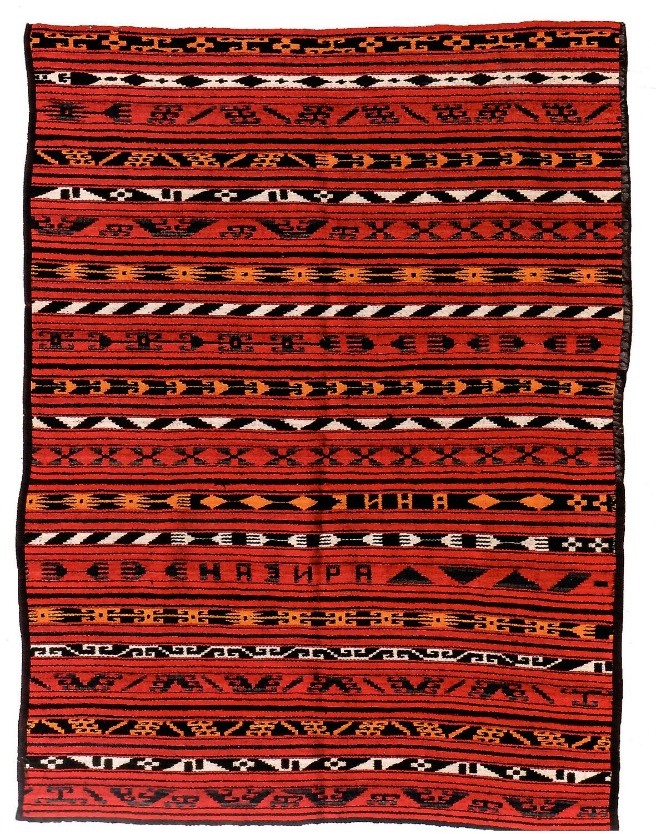
A type of bedspread common in Southern Kazakhstan—the terme alasha—is an item sewn together from six multi-coloured woven strips. The terme technique allows for the creation of clear, graphically expressive patterns.The carpet’s composition consists of a harmonious combination of yellow, red, white, blue and black strips. Their rhythmic alternation forms a balanced yet dynamic ornamental structure.The ornamental decoration includes tumarsha, syrga, ashamay, irek, baldaq and other traditional motifs: tumarsha (amulet) – a protective symbol associated with the idea of protection and well-being; syrga (‘earring’) – a motif associated with femininity and adornment; ashamay – a pattern resembling a child’s saddle, a symbol of care and the continuation of the family line; irek – a wave-like element associated with the image of water and the flow of life; baldaq – an ornament interpreted as a prop or support, a symbol of stability.