
Towel, 1960
Collection of the State Museum of the Republic of Kazakhstan. 53-tk. 1960s. • Taldykorgan Region • Folk artist Kozhabayeva Baysyn • Cotton, satin, lace, coloured threads, tambour stitch
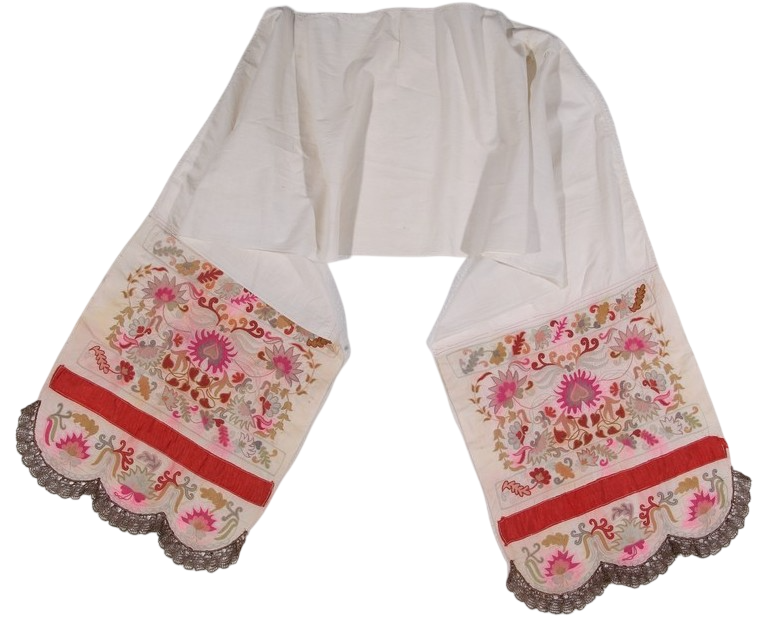
The base of the item is white cotton fabric, characteristic of 19th–20th-century household textiles. The decorative section is executed using the tambour embroidery technique, in which the ornament is formed by chain-like stitches, creating smooth contour lines and a dense filling of the pattern.The composition is symmetrical: the embroidered ornamental panels are situated at both ends of the towel and mirror one another, forming a balanced decorative structure. The lower section is adorned with a wavy border, which creates a rhythmic line and visually completes the composition.Floral motifs take centre stage in the ornamentation. They are represented by stylised rosettes and blossoming flowers, surrounded by flowing plant shoots, leaves and scrolls. Floral symbolism is traditionally associated with notions of vitality, beauty, fertility and prosperity.The colour scheme is based on a combination of bright shades of red, pink, green and ochre against a white fabric background. The contrasting colour palette enhances the decorative expressiveness of the embroidery and emphasises the ornamental structure of the composition.