
Beldemshe, 20th c.
Turkestan Regional Museum of History and Local Lore
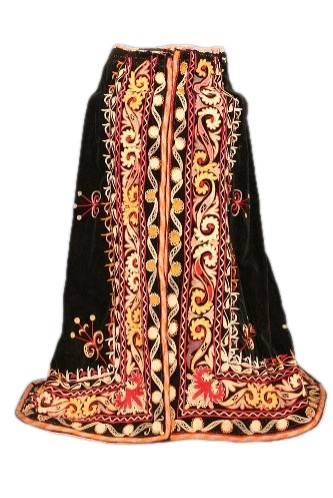
Beldemshe — a split skirt, which is an important part of the traditional Kazakh women’s costume. The garment is made of black velvet, which gives it an elegant and striking appearance. The skirt has a slightly flared cut; the upper part is gathered into a wide, tight waistband, ensuring the garment sits securely at the waist and forms soft folds.The front of the beldemshe is open and richly decorated with embroidery. The main ornamental composition is concentrated on the central vertical bands and along the hem of the garment. The embroidery is executed using the tambour stitch technique with coloured silk threads, creating smooth contour lines and lending the patterns expressiveness and depth.The ornamentation is of a botanical nature and features stylised plant shoots, flowers, leaves and scrolls. These elements form a symmetrical composition centred around the central line of the garment. The rhythmic repetition of the ornamental motifs lends the decorative design a sense of unity and harmony.The colour scheme is based on the contrast between the dark velvet background and the bright shades of the embroidery — red, yellow and light tones.