Traditional and contemporary art of Kazakhstan

A Virtual Journey into the World of Kazakhstan’s Artistic Heritage

This Web Gallery presents the diversity of artistic practices in Kazakhstan, reflecting the continuity of cultural traditions and the dynamic development of contemporary creative processes. The virtual exhibition features works based on national images, symbols, and themes, as well as artworks by contemporary artists who reinterpret the country’s cultural heritage through contemporary artistic forms, expressive means, and modern technologies.

The selected works demonstrate the relationship between traditional and contemporary art, revealing the distinctive features of the national worldview, cultural identity, and cultural meanings. The presented materials allow viewers to trace how elements of historical and cultural heritage are reflected in contemporary artistic practice, while maintaining their significance and relevance in an increasingly globalized world.

The Web Gallery is aimed at promoting Kazakhstan’s artistic heritage, expanding public access to works of art, and fostering a lasting interest in national culture and art among a wide audience.

Keli-kelsap

19th century. Bukhara-Zhirau Regional Museum of History and Local Lore.
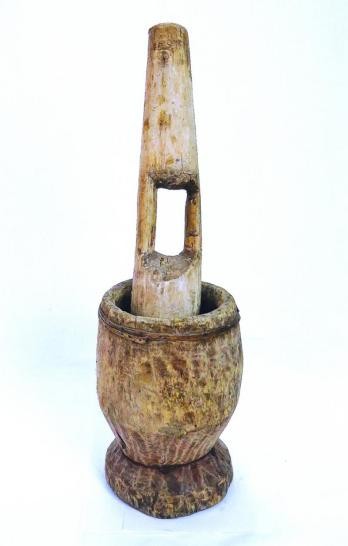
Keli kelsap – a mortar and pestle for grinding cereal grains into groats (Fig. 5). Craftsmen made keli – a mortar – from dried tree trunks with hard wood – oak or birch, cutting out the inside of the log and then burning it to give it a smooth surface. Usually, to prevent the wood from cracking during work, it was heated in a tandoor oven and coated with fat from a camel’s hump. Often, the keli was covered with raw camel skin or a metal rim for strength. Keli come in various sizes, both small and large. The average height of a kelli is 70–80 cm, with a diameter of 30 cm. The laconic, refined shape of the kelli vaguely resembles the outline of a shot glass: the wide upper edge of the mortar gradually narrows at the bottom and widens slightly into a stable base. The kelzap or pestle was made from a single piece of wood about 1 m long with a flat working surface 15 cm wide. Rectangular notches were carved into the kelzap so that it could be easily gripped with both hands by the women during the laborious work of crushing the grains.