
Earrings
East Kazakhstan. Silver, stamped, carved, engraved, blackened. A. Kasteyev National Museum of Arts of the Republic of Kazakhstan
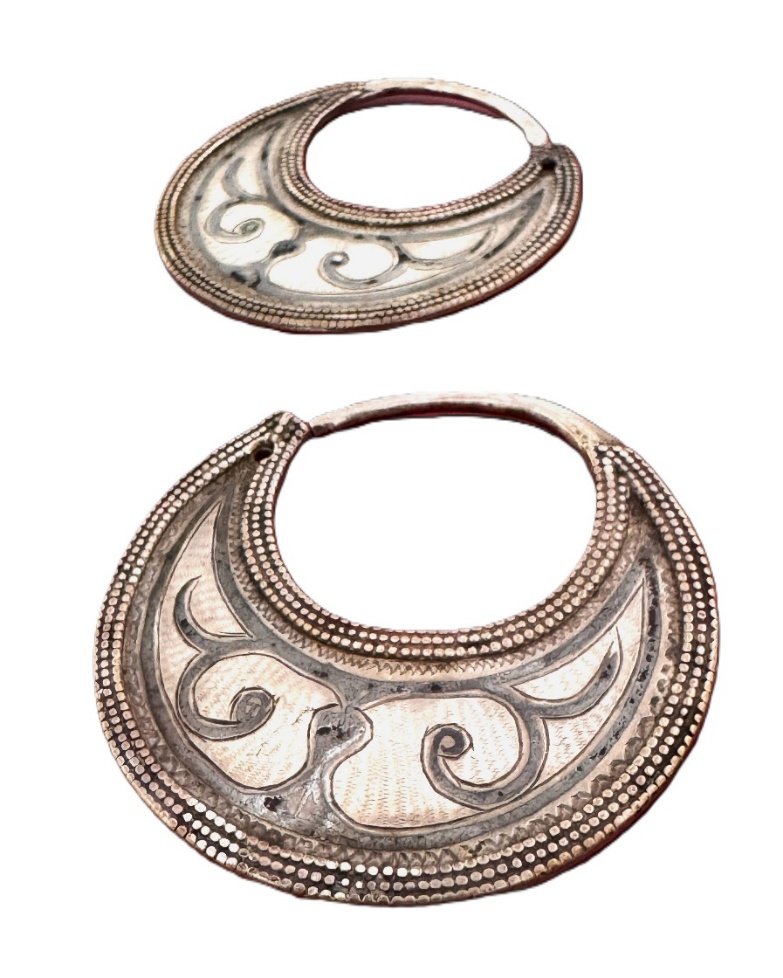
Syrga are ring-and-disc-shaped earrings characteristic of the East Kazakh tradition of jewellery art from the late 19th to early 20th centuries. The piece belongs to the category of everyday and ceremonial jewellery and is distinguished by its expressive, sculptural form.The material is silver; the techniques used include stamping, carving, engraving and blackening. The use of blackening emphasises the ornamentation, creating a contrast between the background and the relief elements.The design consists of a closed ring-shaped base with a widened lower section forming a disc-shaped shield. The upper section features a hole for attaching a clasp. The main volume is concentrated in the lower segment, which forms the piece’s characteristic silhouette.The composition is structured according to a concentric frieze principle. The central field is filled with a floral ornamentation in the form of gently flowing scrolls. Ornamental bands with grain-like and linear decoration run along the edges, framing the main composition and emphasising the shape.The ornamental scheme combines floral and geometric motifs. The scroll elements create a dynamic composition, whilst the blackened background enhances the graphic quality of the design. The contrast between the light metal and the darkened recesses lends the piece expressiveness. Overall, the earrings demonstrate the region’s characteristic tendency to combine a minimalist design with rich ornamentation.