
Aqyk
Western Kazakhstan. Silver, carnelian, granulation, filigree. A. Kasteev National Museum of Arts of the Republic of Kazakhstan
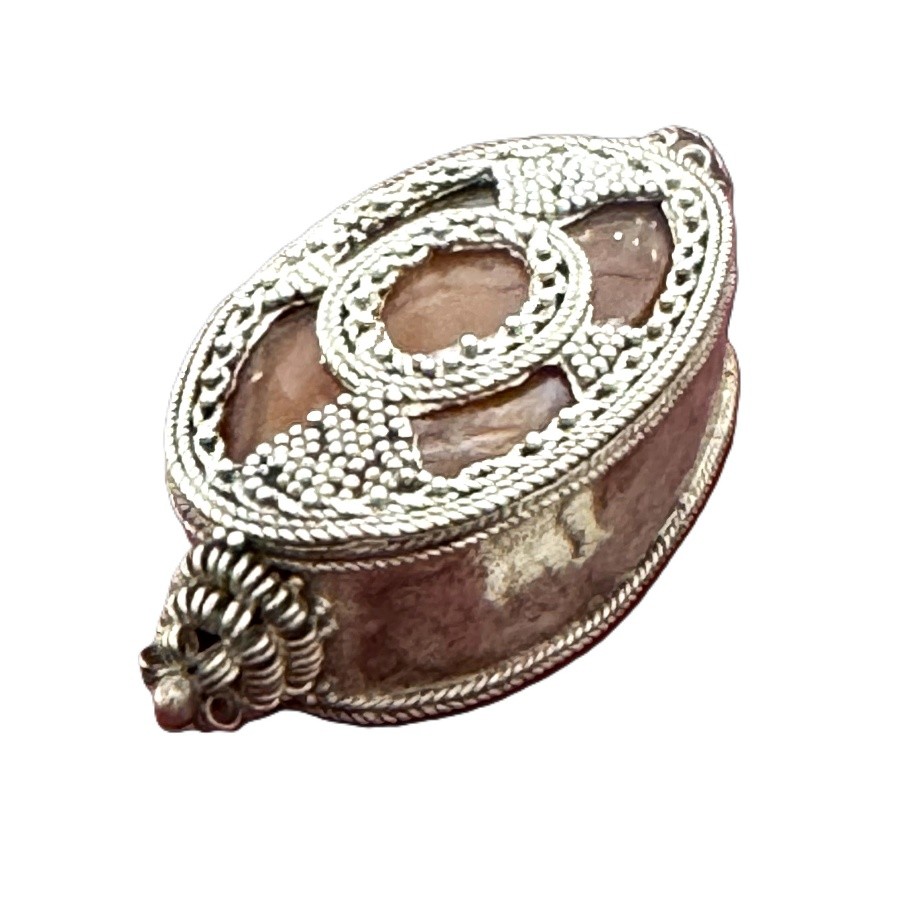
Pendant (aqyk), a neck and chest ornament with a stone inlay. The piece belongs to the category of decorative and amuletic pendants, in which the use of a stone inlay with symbolic meaning plays an important role.The design comprises an oval, three-dimensional body into which a polished carnelian, set in a metal frame, is inserted. The upper part is fitted with an eyelet for hanging. The body has a closed shape with thickened edges and decorative detailing on the end.The composition is based on a centric principle. The focus is concentrated in the central area of the stone setting, partially covered by an applied ornamental element. The metal decoration is arranged in a symmetrical pattern, emphasising the oval shape and drawing attention to the centre.The ornamental system is based on a combination of a scan pattern and granulation. Filigree lines form smooth contours and closed shapes, whilst the granulation creates relief accents and enhances the textural richness of the surface. The contrast between the smooth surface of the carnelian and the openwork metal ornamentation lends the piece expressiveness.Carnelian is traditionally associated with protective and life-giving symbolism, which reinforces the amuletic function of the piece. Overall, the piece demonstrates a combination of concise form, expressive material and delicate ornamental detailing characteristic of the Western Kazakhstani jewellery tradition.