
Bilezik
South Kazakhstan. Silver, gilding, weaving, engraving, casting, twisting. A. Kasteyev National Museum of Arts of the Republic of Kazakhstan
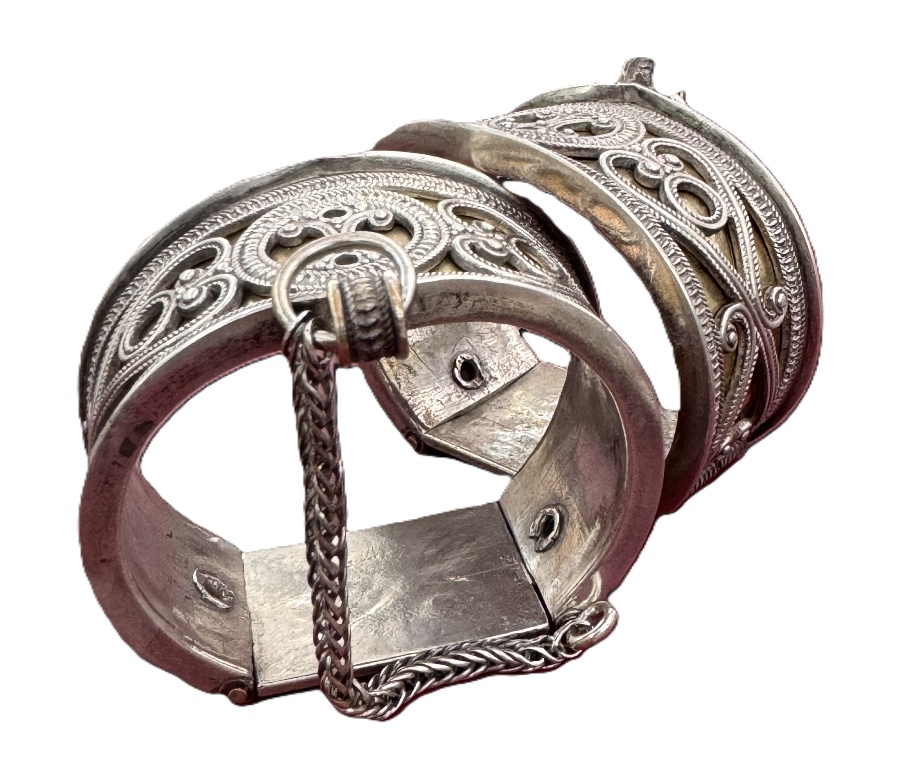
Bilezik. A complex-structured wrist ornament characteristic of the South Kazakhstani tradition of jewellery art in the 20th century. The piece belongs to ceremonial forms and is distinguished by a sophisticated construction combining decorative elements with functional complexity.The material is silver with gilding; the techniques used include casting, engraving, twisting and braiding. The use of various metalworking techniques creates a richly textured surface and enhances the piece’s sculptural expressiveness.The design consists of an almost closed bracelet-like form with a hinged joint. At the top is a movable ring-shaped fastening, to which a twisted braided element is attached, enhancing the decorative mobility. The inner part of the bracelet is made of separate plates joined together, indicating the complex assembled structure of the piece.The composition is constructed on a frieze principle, with a central ornamental band highlighted. The main field is decorated with an openwork ornament dominated by plant motifs—curls, shoots and symmetrically developing lines. The ornament is inscribed within elongated oval shapes, forming a rhythmic sequence along the surface of the bracelet.The ornamental scheme is characterised by the fluidity of its lines and the symmetry of its construction. The plant motifs are combined with a linear border that emphasises the composition’s boundaries. The suspended woven element enhances the decorative effect, adding dynamism to the piece. The contrast between the smooth, gilded and engraved sections lends the piece expressiveness and highlights the high level of jewellery craftsmanship.