
Yuzik
West Kazakhstan. Silver, carnelian, glass, gilding, granulation, stamping, filigree, repoussé. A. Kasteyev National Museum of Arts of the Republic of Kazakhstan
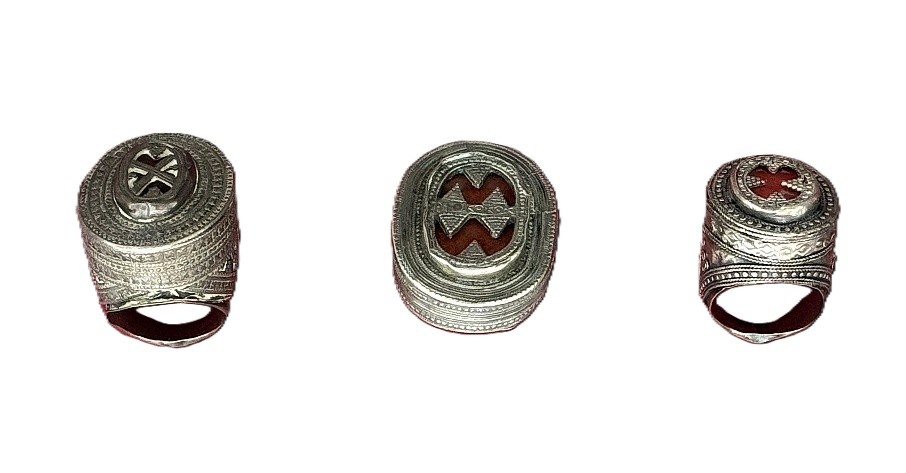
Rings (juzik), a group of items with an oval shield and inlays. This group of rings belongs to traditional women’s jewellery of a status-symbol and amulet nature. The items on display demonstrate the variety of a single typological design, characterised by a large shield and a central inlay.The construction of all the rings is based on a solid shank of a cylindrical or slightly flared type, transitioning into a raised oval or rounded shield. The shields have a distinct multi-layered structure with ornamental bands along the edge. The central part is decorated with carnelian or coloured glass inlays, set in castings and complemented by applied elements.The composition is based on axial and centric principles. In each piece, a central field is highlighted, accentuated by either a cross-shaped or zigzag-shaped applied motif. These elements divide the surface of the inlay into segments, forming a stable symmetrical structure. Concentric ornamental bands are arranged around the centre, creating rhythm and emphasising the compositional completeness of the form.The ornamental system combines geometric and symbolic motifs. The cross-shaped and zigzag elements are associated with traditional notions of protection and the ordering of space. Grained and filigree decoration enhances the textural richness of the surface and creates a shimmering effect. The use of coloured inlays (carnelian, glass) forms a striking contrast with the silver base and emphasises the decorative and status-symbol function of the pieces.Overall, this group of rings reflects the characteristic features of the West Kazakh jewellery school: monumental forms, a clear compositional structure, and a combination of sculptural expressiveness with rich ornamental decoration.