
Kapsyrma
North Kazakhstan. Silver, carnelian, repoussé, blackening, stamping. A. Kasteyev National Museum of Arts of the Republic of Kazakhstan
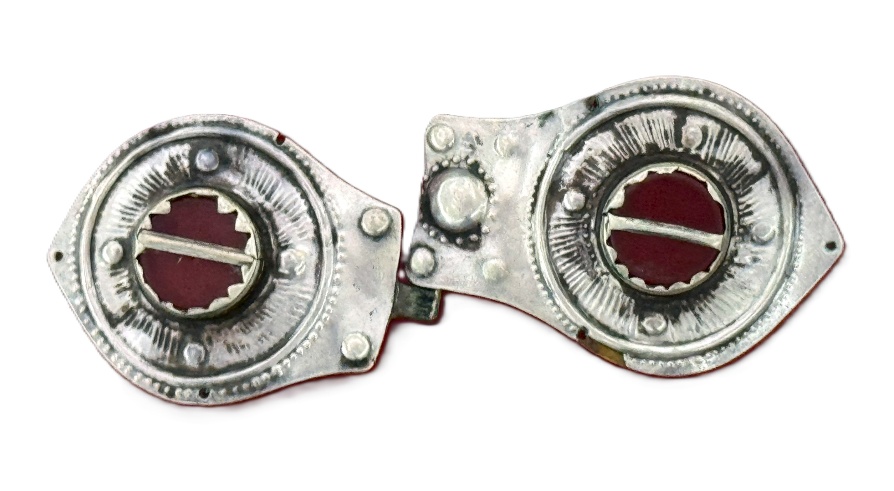
Kapsyrma (clasp). The item is a belt fastening element that serves to secure the garment whilst simultaneously providing a decorative accent to the central part of the costume. Structurally, it consists of two rounded flaps connected by a hinge mechanism, ensuring both mobility and a secure fastening.The composition is based on the principle of axial symmetry. Each flap has an almost circular silhouette with lateral projections, forming a single shape when closed. The central sections are adorned with carnelian inlays, set in sockets with serrated edging and crossed by a horizontal metal bar that serves a structural and securing function.The ornamental structure consists of radially arranged elements: concentric zones with a ray-like relief are combined with protruding hemispherical details. The blackening technique enhances the depth of the design and emphasises the sculptural treatment of the surface.Technologically, the piece demonstrates a combination of stamping, which forms the base, and embossing, which refines the relief elements. Blackening is used to create a contrasting graphic effect, whilst carnelian inlays introduce a colour accent into the composition.Overall, the clasp reflects the orientation towards a centred composition with a distinct decorative core, characteristic of the North Kazakhstan tradition, where structural elements are organically integrated into the artistic design of the piece.