
Quyysqan (crupper)
Leather, metal, stamped. A. Kasteev National Museum of Arts of the Republic of Kazakhstan
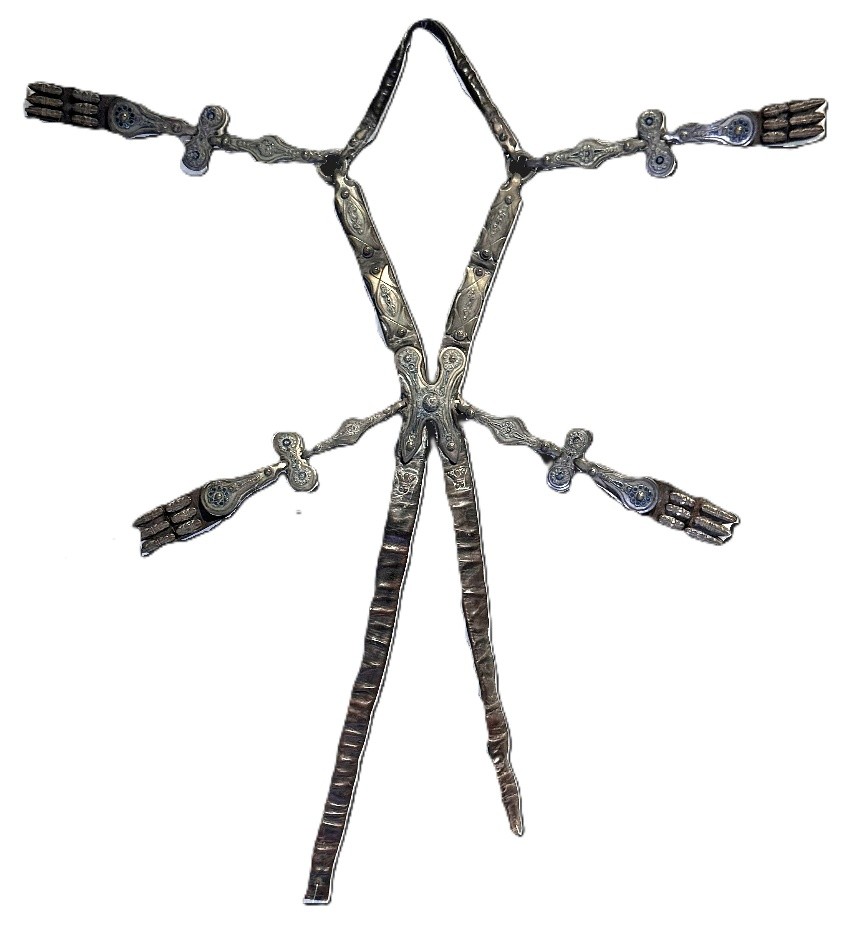
Kuysqan (tail strap) The item is an element of horse harness — a tail strap designed to secure the saddle and prevent it from shifting. The design comprises a system of leather straps joined in the centre and supplemented by side branches with decorative ends.The base consists of elongated leather straps forming a vertical axis and diverging diagonal elements. The upper part features a connecting section that secures the saddle. The central point of the composition is highlighted by the intersection of the straps and reinforced with metal plates.The decorative design focuses on the metal elements fixed at the joints and at the ends of the straps. The plates are produced using a stamping technique and feature a complex shape with symmetrical extensions. The end elements are designed in the form of stylised blade-like or finger-like shapes, which lends the composition an expressive plasticity.The ornamentation features geometric and botanical motifs executed in shallow relief. The decoration is arranged symmetrically about a central axis, with the side elements forming a balanced, branched structure.The composition is characterised by a combination of a rigid structural scheme and decorative detailing. The contrast between the textures of leather and metal enhances the visual perception of the piece.Technologically, the object was produced using leatherworking techniques (cutting, shaping of straps) and the manufacture of metal plates by stamping followed by assembly.The tail guard falls into the category of utilitarian items of horse tack; however, its artistic design reflects a desire to aestheticize even the functional elements of the harness, which is a characteristic feature of traditional culture.