
Centaur, 2024. Bronze. Almaty
Dauren Dosmagambetov
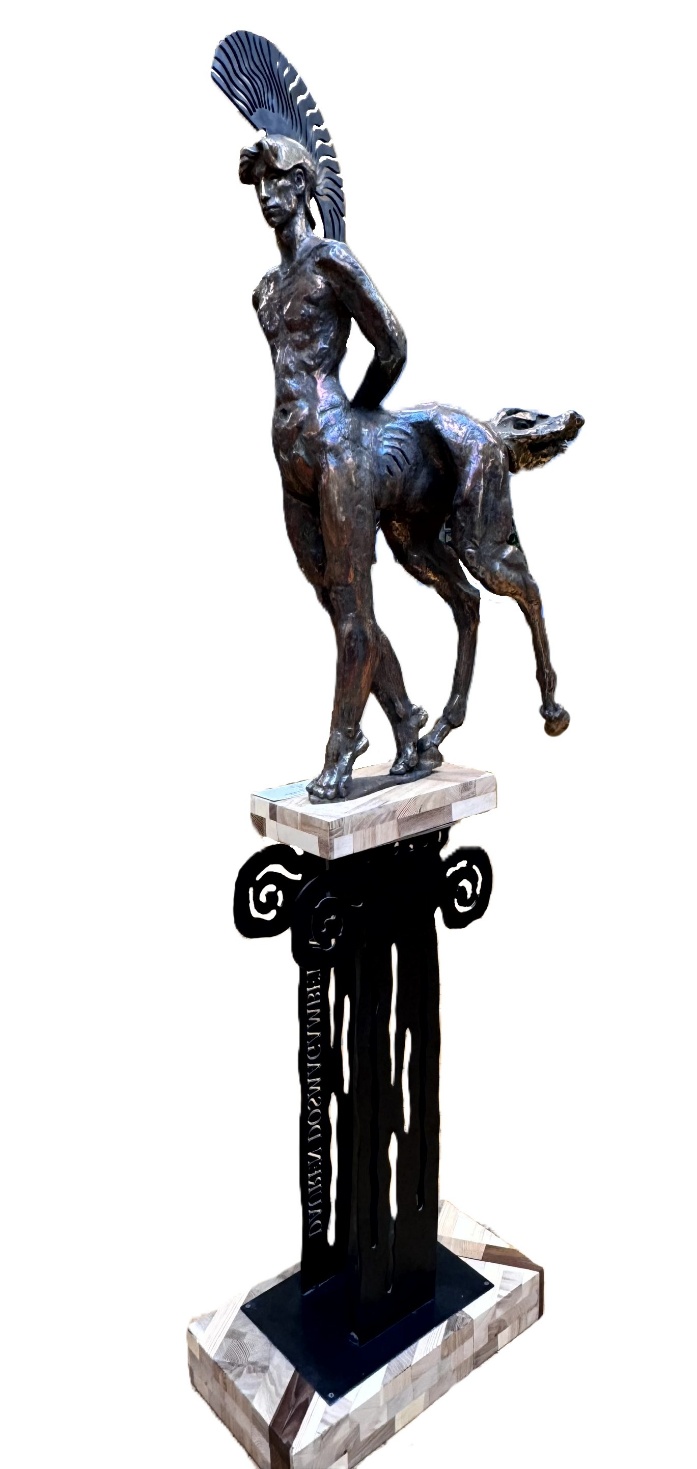
In this work, the classical mythological image of the centaur receives a contemporary sculptural interpretation, in which the ancient narrative is reimagined through the language of generalised form and the artist’s own symbolism. Bronze allows the artist to combine sculptural monumentality with a subtle textural treatment of the surface, giving the composition an expressive material depth.The figure is constructed in a stable spatial equilibrium, yet an internal dynamism is maintained through the complex interplay of human and animal elements. The upper part of the figure is rendered in a more vertical and restrained manner: elongated proportions and stylised anatomy emphasise the rational and spiritual elements. The lower part, by contrast, is characterised by greater plastic tension and a sense of movement, which reinforces the association with instinctive natural force. This contrast forms the internal conflict of the composition, based on the interplay between the conscious and the elemental.The head element, resembling simultaneously a crest, a helmet and a ritual symbol, plays a significant role in the structure of the image. It reinforces the verticality of the silhouette and evokes associations with military symbolism, and archetypes of defence and strength. This emphasis becomes an important part of the work’s visual system, highlighting the character’s heroic and sacred nature.The textural organisation of the surface is built on an alternation of smoothed and rough areas. Traces of modelling and shaping preserve the sense of a living, plastic process and emphasise the work’s authorial nature. Light, interacting with the bronze surface, reveals the structure of the volumes and enhances the expressiveness of the silhouette, thanks to which the figure is perceived differently as the viewer moves around the object.The artist’s interpretation of the centaur transcends the bounds of ancient mythology and takes on a universal philosophical significance. It becomes a metaphor for the dual nature of humanity, uniting culture and instinct, reason and the natural element.