
Zheruyyk. 2003. Tapestry, weaving.
Gaziz Eshkenov
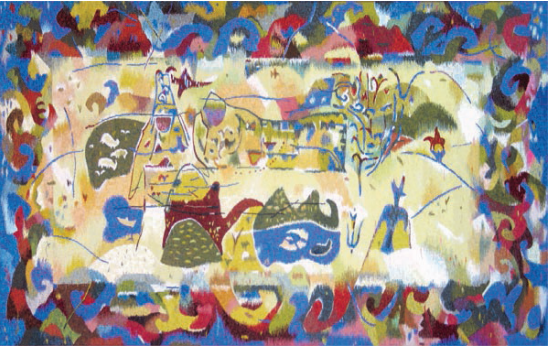
The tapestry ‘Zheruyyk’ is an artistic interpretation of one of the most significant mythopoetic images in Kazakh culture — a utopian land of prosperity associated with the legend of Asan Kaygy. The work reinterprets the traditional narrative as a symbolic model of collective memory, the national ideal and the spiritual quest for harmony.The composition of the tapestry is structured according to the principle of a panoramic vision, reminiscent at once of a map, a mythological space and a stream of memories. Within a single pictorial field, various symbols of steppe culture coexist: silhouettes of yurts, outlines of mountains, figures of animals and horsemen, and ornamental motifs. These elements are not subject to the laws of realistic perspective, but are organised as a system of cultural symbols that form the image of an idealised homeland. Semiotically, ‘Zheruyyk’ functions as a visual text in which each element serves as a sign of a collective conception of a harmonious world. The work’s colour scheme takes on particular significance. The predominance of golden-yellow, ochre and sky-blue tones creates a sense of light, warmth and inner harmony. Here, colour serves not a descriptive but an emotional and symbolic function: shades of yellow are associated with vital energy and the sun, whilst shades of blue evoke the boundlessness of the sky and the freedom of the steppe. Contrasting splashes of red and deep blue enhance the composition’s dynamism and create a sense of continuous movement.