Traditional and contemporary art of Kazakhstan

A Virtual Journey into the World of Kazakhstan’s Artistic Heritage

This Web Gallery presents the diversity of artistic practices in Kazakhstan, reflecting the continuity of cultural traditions and the dynamic development of contemporary creative processes. The virtual exhibition features works based on national images, symbols, and themes, as well as artworks by contemporary artists who reinterpret the country’s cultural heritage through contemporary artistic forms, expressive means, and modern technologies.

The selected works demonstrate the relationship between traditional and contemporary art, revealing the distinctive features of the national worldview, cultural identity, and cultural meanings. The presented materials allow viewers to trace how elements of historical and cultural heritage are reflected in contemporary artistic practice, while maintaining their significance and relevance in an increasingly globalized world.

The Web Gallery is aimed at promoting Kazakhstan’s artistic heritage, expanding public access to works of art, and fostering a lasting interest in national culture and art among a wide audience.

Vessel, 2010. Faience, glaze. Source: Kazakh Art, Volume 5. Almaty, 2013

Reshat Kozakhmetov
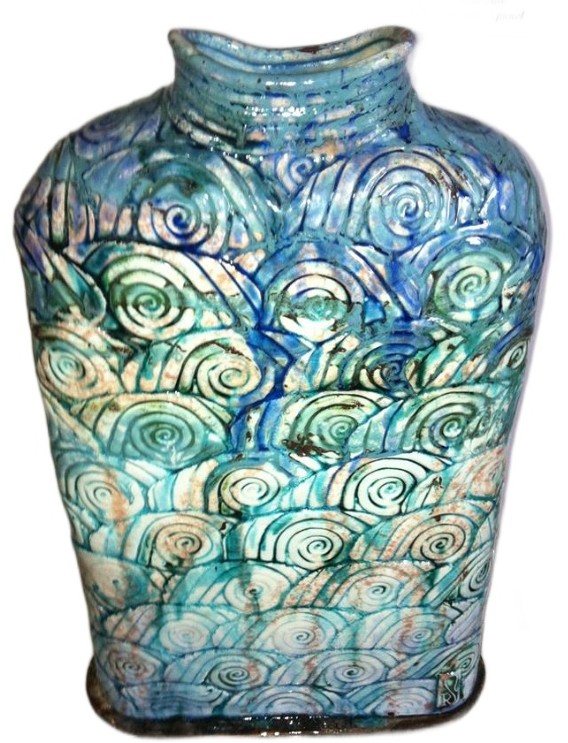
This work can be interpreted as an example of the reinterpretation of an archaic form. In artistic culture, any vessel is a universal symbol of the receptive feminine principle – the womb of the Great Mother.The sculptural treatment of the form emphasises the artist’s departure from classical symmetry and smoothness. The ornamental design takes on particular significance. Repeating spiral motifs form the rhythmic structure of the surface and serve as an important semiotic code for the work. The spiral is one of the oldest universal symbols, associated with the ideas of infinity, the cyclical nature of time, movement and the continuity of life. In this context, the ornament transcends its purely decorative function and becomes a visual expression of the concept of eternal return and cultural continuity. The colour palette, based on a combination of turquoise, blue and white shades, reinforces associations with the traditions of Central Asian ceramics, where the colours of water and the sky symbolise purification, harmony and humanity’s connection with the cosmos.