
‘From the Sign’, 2016
Serzhan Bashirov • Assemblage. Wood, brass. 20×45. Photo by Serikzhan Iskakbek
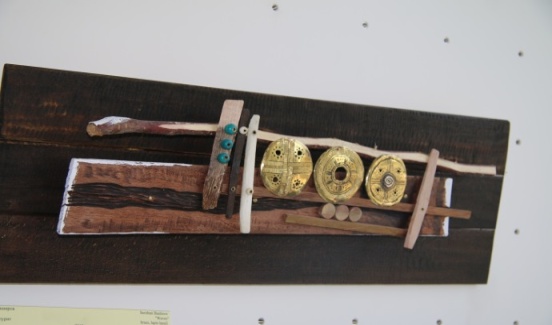
In Serzhan Bashirov’s assemblage *3 Signs* (2016), against the backdrop of an elongated rectangle assembled from three tinted planks, there are ‘traces’ of a tangible human presence. Thus, in the upper part of the work is a partially hewn branch – an image of the result of human interaction with nature. At the bottom is a wide plank with white-painted ends and a central stripe (the river of life?), highlighted by the texture of elongated, charred cuts. Various small wooden blocks are positioned vertically and at an angle, apparently symbolising the boundaries between different periods of life. Between them are three round brass medallions with engraved decoration. These asymmetrical circular forms, also grouped in threes, recur in various parts of the installation and allude to the archaic symbolism of the solar sign and the well-known semantics of the number three—one of the archetypes developed by C. Jung, signifying the harmony of the world. In Kazakh folk culture, the metaphorical meanings of the triadic constant are well known: et-zhan – the soul of the flesh; shybyn-zhan – the soul, human life; ruh-zhan – the spirit; and the colours: white (aq) – sacred; yellow (sary) – the colour of the sun; blue (kok) – the colour of the sky, the abode of the divine Tengri. The artist transforms images of the surrounding world, employing the aesthetics of associative thinking not through illusory forms of reality, but through their symbolic likenesses, and applying the jewellery craftsmanship inherited from folk traditions to the composition of the visual space of the art object.
Source: from S. Bashirov’s personal collection