
Terme alasha, second half of the 20th c.
2nd half of the 20th century. Atyrau Region. Collection of the Central State Museum of the Republic of Kazakhstan
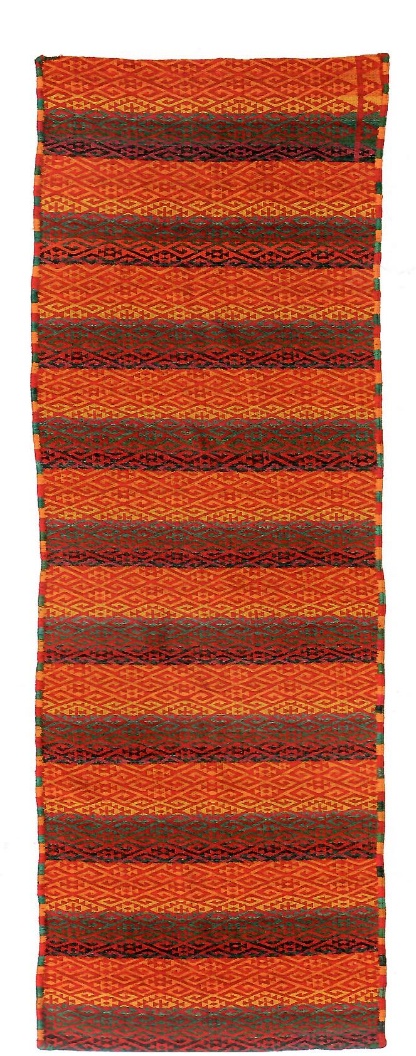
A unique type of bedspread in terms of its ornamental design – the terme alasha – is woven from ten multicoloured strips alternating in shades of yellow, orange and blue. The contrasting yet harmoniously balanced colour palette lends the piece a distinctive decorative expressiveness.The main patterns in the Kazakh tradition are known as ashtarkhan teru and qarmaq. Such figures are among the most archaic and are found in various configurations on Andronovo pottery. The qarmaq (‘hook’) motif is one of the oldest geometric elements found in the ornamental culture of Eurasia. It can be interpreted as a protective sign, a symbol of retention and defence. The term ‘ashtarkhan teru’ is of particular interest. The word ‘Ashtarkhan’ itself, in the Kazakh language, is the historical name for the city of Astrakhan (Turkic: Ashtarkhan, Khadzhi-Tarkhan). This place name was widely used in the steppe environment and became firmly established in the oral tradition.